Why a Simulation Report Should Show Its Mesh Check on Page One
Most simulation reports bury the mesh check in an appendix, if they include it at all. I think it belongs on page one, beside the number the decision depends on. Here is why, and what that block should contain.
When a simulation report lands on my desk for review, I turn to the mesh check before I read the summary. In most reports I have to hunt for it. Sometimes it is a single line in an appendix saying the mesh was "found to be adequate". Sometimes it is a plot of global displacement against element count, which tells me nothing about the stress the conclusion depends on. Quite often it is not there at all.
My view, after years of writing and reviewing FEA and CFD reports, is simple. The mesh check belongs on page one, right next to the result it supports. Here is why, and what I think that block should contain.
1. The headline number is only as good as the mesh behind it
Every report has one or two numbers that drive a decision: a peak stress against an allowable, a velocity at a critical point, a temperature at a rack inlet. If those numbers shift when the mesh is refined, the decision can flip. The client reading the summary has no way of knowing that unless the report tells them.
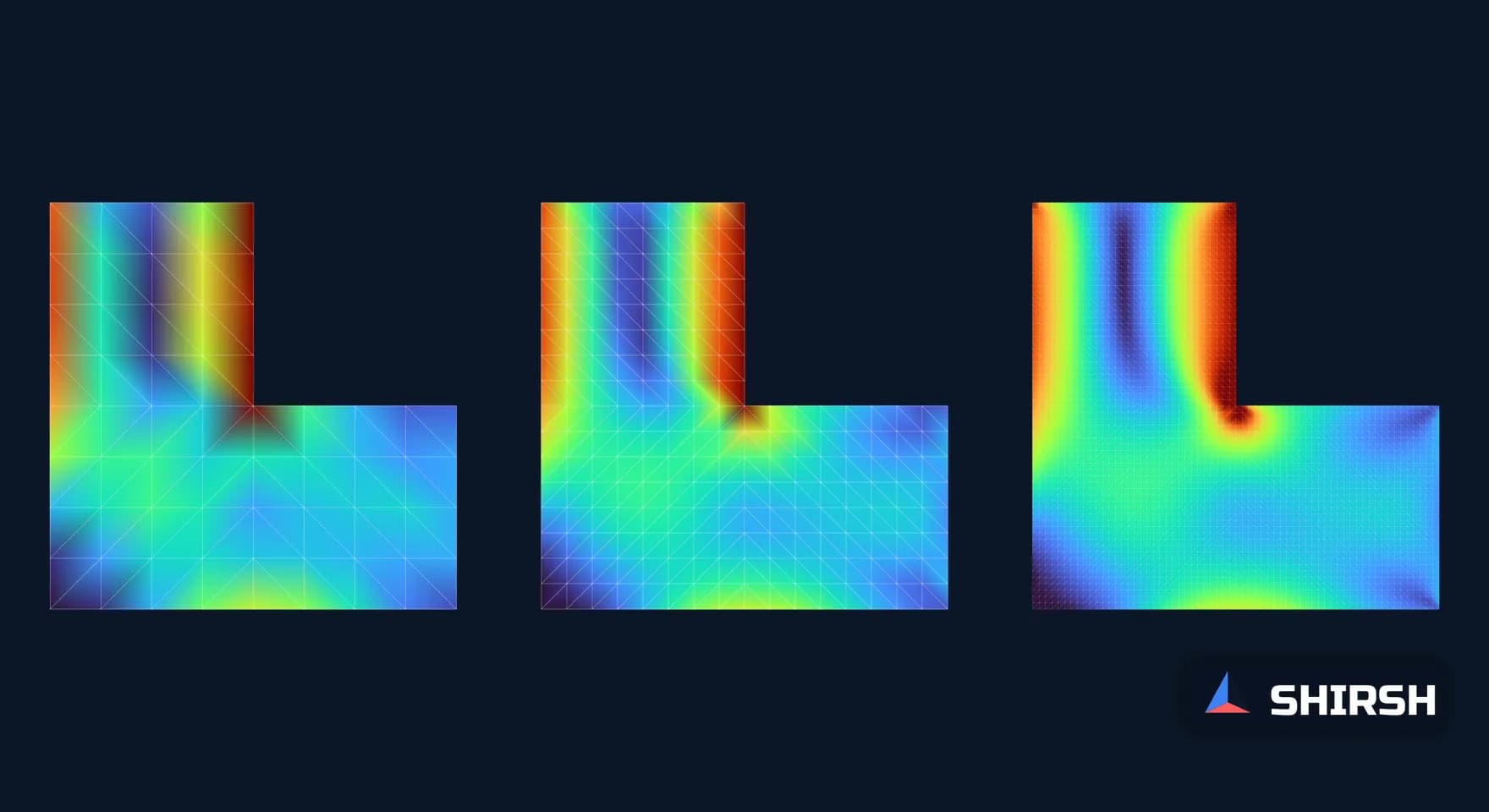
We showed how far this can go in our Insight on stress singularities. A simple L-bracket with a sharp inside corner gave a peak von Mises stress of 315 MPa on a 4 mm mesh and 887 MPa on a 0.25 mm mesh, with no sign of levelling off. The same bracket with a 5 mm fillet settled at 238 MPa, and the stress 5 mm away from the sharp corner barely moved, from 65.3 to 64.7 MPa across the whole range. Any single one of those sharp-corner values could have gone into a summary table looking perfectly respectable.

What a page-one mesh check can look like, using the published L-bracket numbers. The plot and the table sit next to the result they support, and they say what was not reported as well as what was.
2. Fluids engineers settled this question a long time ago
CFD has had a published expectation for years. The Journal of Fluids Engineering states that it will not consider a paper reporting a numerical solution of a fluids engineering problem without systematic truncation error testing and accuracy estimation. Its procedure, written by Celik, Ghia, Roache and Freitas, asks for three significantly different grids, a refinement ratio between them that is desirably greater than 1.3, and a grid convergence index computed with a factor of 1.25. ASME V&V 20-2009 builds numerical uncertainty into the validation comparison itself, and ASME V&V 10 does the equivalent job for computational solid mechanics.
None of this is exotic. If an archival journal will not accept a result without an accuracy estimate, I see no reason why a design decision on a pressure vessel or a cleanroom layout should accept less.
3. A mesh check in the appendix gets skipped
My concern is partly practical. Reviewers are busy, and project managers are busier. When the mesh study is on page 47, most readers never reach it, and the ones who do find it disconnected from the number in the summary. When it is on page one, the reader sees the result and the evidence for it together. If the evidence is thin, that is visible immediately, and the conversation happens before the drawings are released, not after.
It also changes how the analyst works. Knowing that the convergence plot will sit beside the headline result, you check it at the right location. A global mesh study that shows displacement converging is easy to produce and almost useless for a stress conclusion, because displacement converges long before local stress does. Putting the check on page one forces it to be about the quantity that matters.
4. What I put in the page-one block
On our own reports, the block is short. It states the quantity reported and exactly where it sits, so the reader can see the peak has not wandered to a support or a load point between meshes. In the filleted L-bracket, at the two finest meshes the model maximum moved to the fixed-edge corner, which is itself a singularity. Reading only the maximum would have pointed at the boundary condition instead of the part.
Next comes the number of meshes compared and the element size at the location of interest, with the result for each, preferably as a small plot. Then the change between the last two meshes, or a grid convergence index for CFD, and a one-word verdict on whether the value is converged. Finally, the items deliberately not reported as results: singular corners, support artefacts, regions where the model is known to be unreliable. That last line is the one most often missing, and in my experience it is the one that prevents the most arguments.
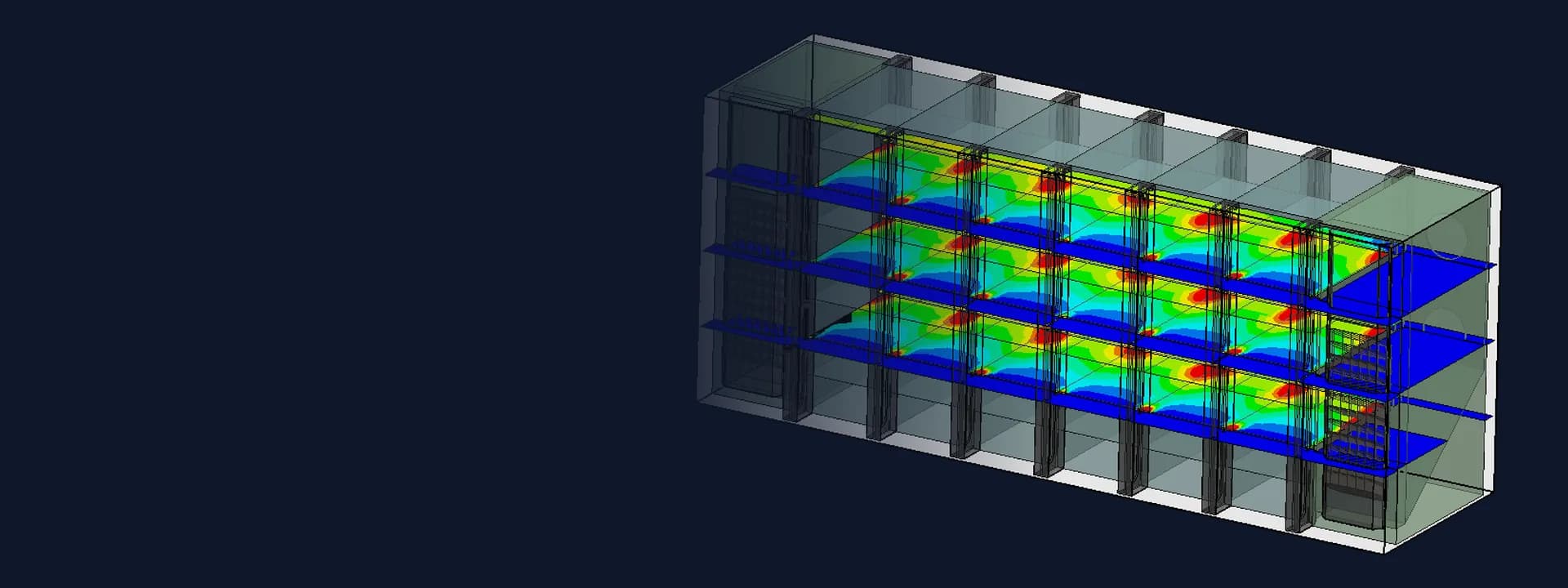
For CFD the same block works with small changes. In our Grade A laminar airflow study, the most sensitive case was repeated with the cell size halved from 6 cm to 3 cm. The main conclusion held, with first air at the vials staying at 0 percent, while the individual path percentages moved by up to about 10 points. Saying both things plainly told the reader which numbers to rely on and which to read as a picture of the flow.
5. What it costs, and what it saves
A proper mesh check at the critical location costs a few extra solves. On a modern workstation with ANSYS Mechanical, CalculiX or OpenFOAM, that is usually hours, sometimes a day for a large transient CFD model. It is rarely the expensive part of a project.
What it saves is harder to put a figure on, so I will not try. I can say that many of the disagreements I am asked to settle between a designer and a reviewer come back to one question: is that number real? A report that answers it on the first page removes the question before anyone has to ask it.
6. What I would ask reviewers to demand
If you commission or approve simulation work, ask for the mesh check on page one, at the location of the governing result, with at least three meshes and the change between them stated. Ask where the peak sits on each mesh and what was left out of the results, and why. If the analyst cannot give you these on one page, the result probably is not ready to base a decision on.
Where Shirsh fits
At Shirsh Technosolutions we carry out FEA and CFD studies with the mesh check and its limits stated up front, and we review simulation reports prepared by others for designers, owners and approving engineers. If you have a report whose headline number you are not sure about, please get in touch.
References: I. B. Celik, U. Ghia, P. J. Roache, C. J. Freitas, "Procedure for Estimation and Reporting of Uncertainty Due to Discretization in CFD Applications", Journal of Fluids Engineering editorial policy statement. ASME V&V 20-2009, Standard for Verification and Validation in Computational Fluid Dynamics and Heat Transfer. ASME V&V 10, Standard for Verification and Validation in Computational Solid Mechanics.
Related case studies

Want to Apply This to Your Product?
Our engineers can help you implement these techniques on your specific components and assemblies.
Get insights like this in your inbox
Engineering deep-dives, simulation tips, and industry analysis. No spam, unsubscribe any time.