Renewable Energy – Solar
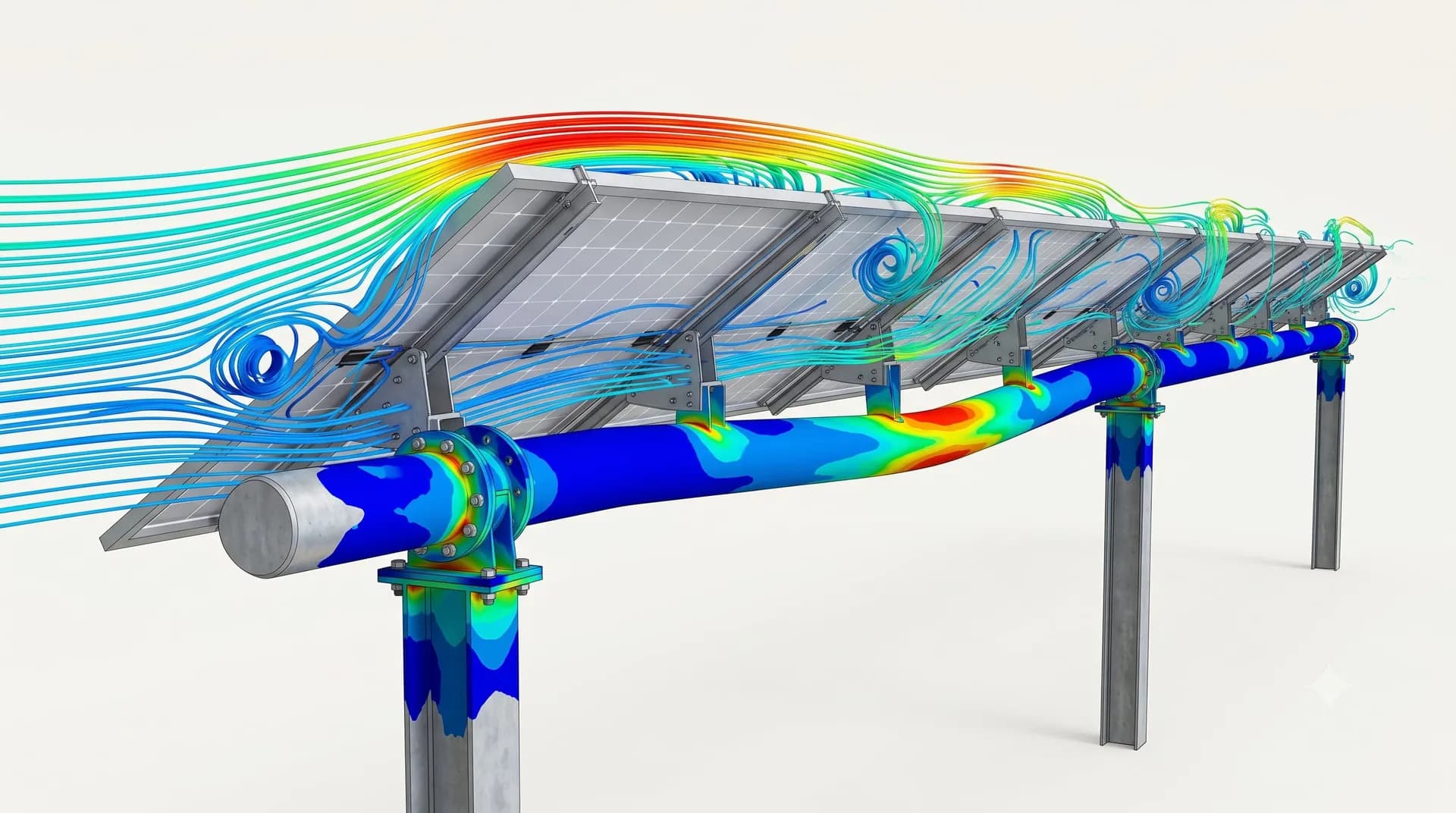
Structural and mechanical reliability in solar mounting systems depends on far more than basic load calculations. Shirsh TechnoSolutions supports fixed-tilt systems, trackers, rooftop structures, carports, and walkways with engineering grounded in cold-formed member behavior, wind response, connection integrity, and serviceability.
Industry overview
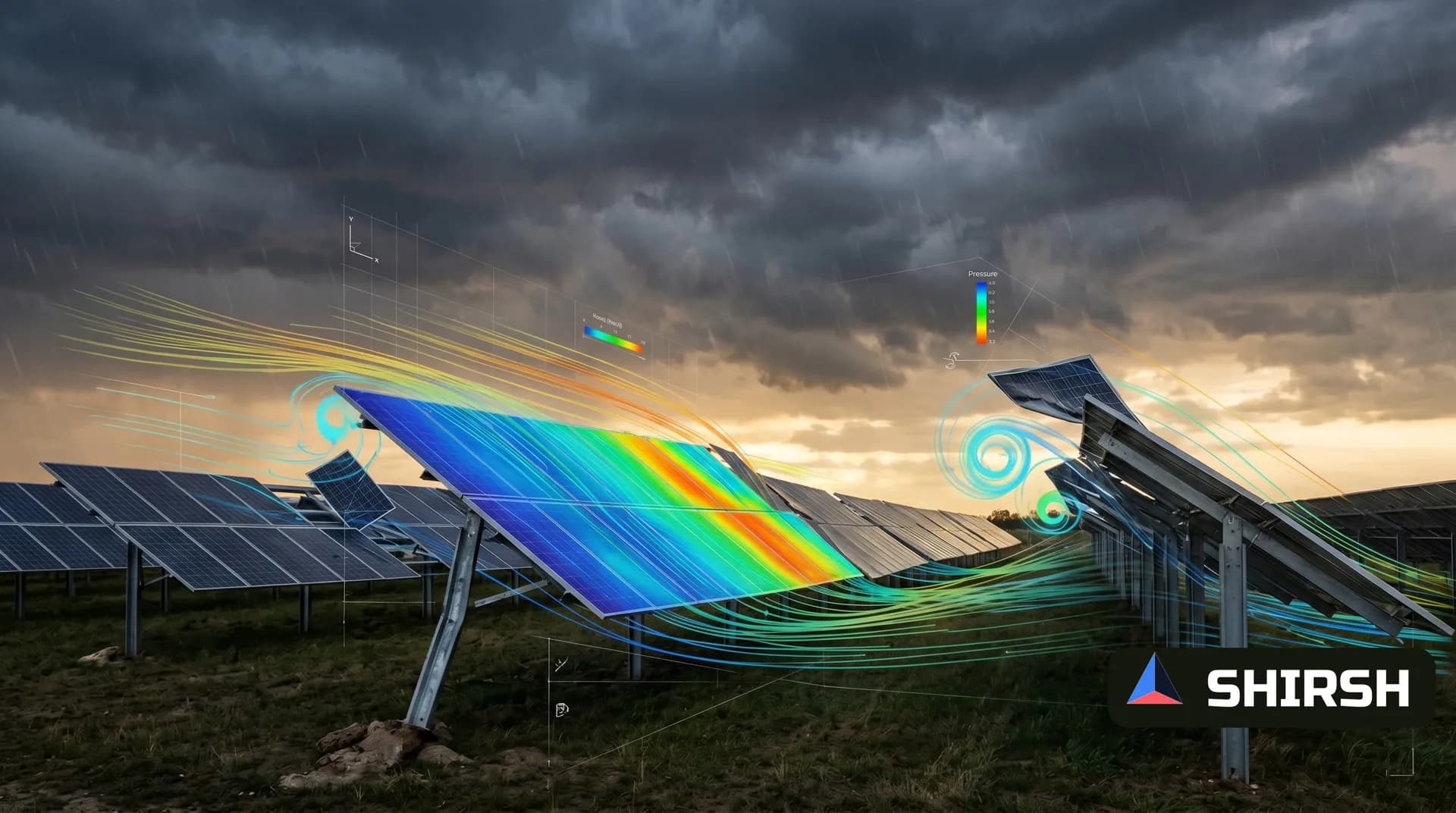
A solar MMS that deflects 40 mm under wind causes panel misalignment, micro-cracking, and warranty disputes. A tracker torque tube that resonates with wind gusts at 3–5 Hz can destroy drive gear teeth within one monsoon season. These are not edge cases — they are recurring structural failures in projects across Rajasthan, Gujarat, and Maharashtra. What looks like a repetitive galvanized steel system is actually governed by cold-formed section instability, connection rotational stiffness, pile head fixity assumptions, and long-run thermal movement. Getting these wrong costs ₹15–40 lakhs per MW in rework, delayed commissioning, or insurance claims.
Shirsh TechnoSolutions works on the mechanical and structural engineering side of solar projects — not on the electrical or procurement side. Our scope typically covers design validation of module mounting systems, structural optimization of purlins and rails, connection and bracket checks, serviceability assessments under AS/NZS 1170, IS 875 Part 3, and ASCE 7 wind loads, and root-cause analysis of field failures. We work with fixed-tilt ground-mount systems, single-axis trackers, rooftop ballasted and anchored structures, solar carports, and agrivoltaic steel frameworks. Projects we have supported range from 1 MW rooftop installations to 50 MW ground-mount utility systems.
Our tools include ANSYS Mechanical for nonlinear structural response and submodel-level connection analysis, SolidWorks for detailed part and assembly modeling, and code-based hand calculations cross-verified against FEA outputs. We understand that field practicality matters — an optimized section that cannot be bolted by a crew on a hot Gujarat afternoon is not a useful solution. Engineering recommendations from our team are framed with fabrication tolerance, erection sequence, and site condition in mind.
Industry challenges
Wind load interpretation for lightweight solar structures under IS 875 Part 3 and ASCE 7 — dynamic pressure coefficients for inclined panel arrays differ significantly from building envelope assumptions, and errors of 20–30% in design wind pressure are common in generic MMS designs.
Local and distortional buckling in cold-formed purlins, rails, and torque tubes — C-sections, Z-sections, and square hollow sections under combined bending and torsion can buckle at loads 30–45% below their gross section capacity if effective width method or DSM is not applied correctly per AS/NZS 4600 or IS 811.
Connection and bracket flexibility causing load redistribution — a single-bolt clamp joint with 0.3° rotational slack multiplied across 60 module bays produces mid-span deflections exceeding L/150 serviceability limits, leading to panel sagging and framing stress concentrations that crack anodized aluminum extrusions.
Tracker torsion and torque tube resonance — single-axis tracker torque tubes spanning 6–8 m between piers develop torsional natural frequencies that can fall within the 0.5–5 Hz vortex shedding range for wind speeds common in Thar Desert and Deccan Plateau sites, requiring stiffness tuning or damper specification.
Thermal expansion mismatch in long structural runs — a 100 m galvanized steel rail system experiences 60–70 mm of free thermal movement across a 50°C annual temperature range in western India, and structures without slip joints or sliding connections develop pile bending moments 3–5× the design value within two years.
How we help
- 1
MMS structural design validation using ANSYS Mechanical — full 3D FEA of purlin, rail, and post assemblies under IS 875 Part 3 wind, dead, and live load combinations, with stress, deflection, and buckling utilization reports referenced to IS 800 and AS/NZS 4600 as applicable.
- 2
Cold-formed section behavior review including local, distortional, and global buckling checks — effective width method and Direct Strength Method calculations for C-sections, Z-sections, and hollow sections used in MMS rails and tracker torque tubes, with section optimization for weight-to-stiffness ratio.
- 3
Connection and bracket design checks at critical joints — pin, bolt, and clamp joint analysis using ANSYS Mechanical contact modeling to quantify rotational stiffness, load transfer efficiency, and fatigue life at high-cycle connection points, with redesign recommendations for bracket geometry and bolt preload.
- 4
Tracker torsional stiffness and dynamic response assessment — torsional natural frequency extraction using modal FEA, comparison against site wind spectra, and stiffness modification or damper specification to avoid resonance in single-axis tracker systems per structural dynamics principles.
- 5
Root-cause analysis of structural distress in fielded systems — on-site measurement correlation with FEA models to identify causes of cracked welds, buckled sections, loose connections, and pile settlement in operating solar plants, with repair specification and design change recommendations to prevent recurrence.
Key trends
Cold-formed steel displacing hot-rolled sections in ground-mount MMS below 50 MW — thinner-gauge, higher-strength S550 and S700 material grades from TATA Steel and JSW are entering solar BOM lists by 2024–2025, requiring effective width and DSM buckling methods rather than standard IS 800 plastic or compact section checks.
Single-axis tracker adoption in India crossing 60% of new utility-scale capacity by 2025, with tracker OEMs demanding structural engineering sign-off on torque tube sizing, pier spacing, and drive torque limits — a gap that most civil contractors are not equipped to fill.
Wind tunnel and CFD-informed pressure coefficients replacing generic code tables for large solar farms — projects above 20 MW on flat terrain in Rajasthan and Gujarat are seeing insurers and lenders require site-specific wind pressure envelopes, especially for bifacial panels with higher drag coefficients on the underside.
Serviceability limit state governing design ahead of ultimate limit state — with module warranties specifying maximum relative displacement between clamp points below 5 mm and racking systems specifying twist limits below 1°/m, deflection and rotation controls are becoming the binding design constraint in lightweight MMS, not stress.
Lifecycle cost and corrosion durability replacing minimum-tonnage as the procurement metric — EPC contractors reporting ₹8–12 lakh/MW in O&M costs linked to corrosion-driven bolt seizure, section thinning, and connection loosening in coastal and humid inland sites are now requesting 25-year durability assessments at tender stage.
Industry insights
Why Single-Axis Solar Trackers Need FEA, CFD, and Aeroelastic Analysis — Not Just IS 875
ReadWhy Fixed-Tilt Ground-Mount Solar Structures Fail
ReadHow to Check a Cold-Formed Solar Mounting Structure to IS 801: A Step-by-Step Guide
ReadFour Quiet Ways the IS 875 Wind Load Goes Wrong on a Solar Array
ReadWant to learn this?
We also offer ANSYS & SolidWorks training courses.
Relevant solutions & software
Relevant solutions
At a glance
Bring code-compliant engineering to your next project
Tell us about your engineering needs — sizing, validation, troubleshooting, training.