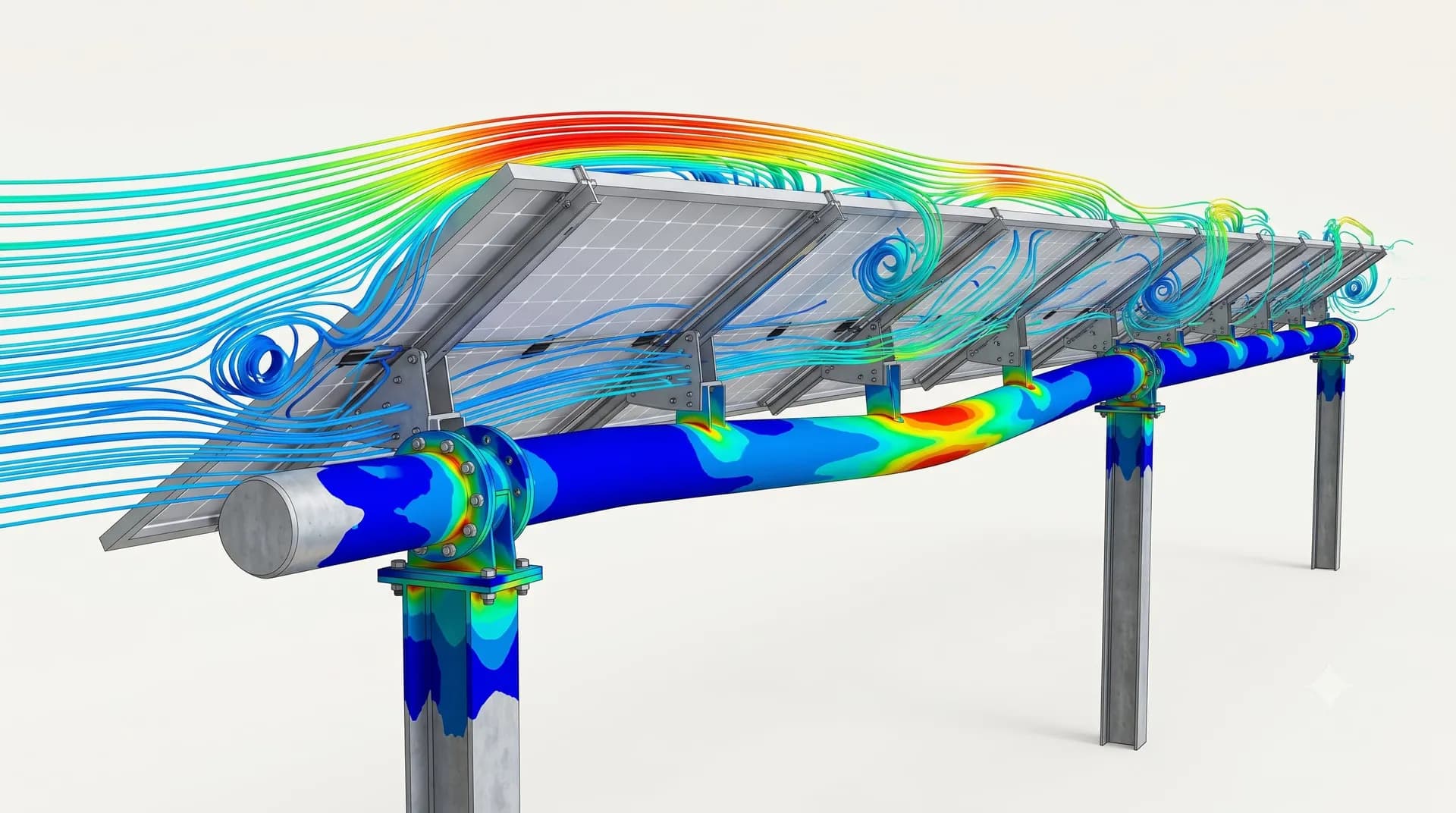
Why Single-Axis Solar Trackers Need FEA, CFD, and Aeroelastic Analysis — Not Just IS 875
A single-axis solar tracker can clear every line of IS 875, pass its STAAD model, and still fail in a windstorm that never reached the code design speed. The reason is uncomfortable but simple: the code hands you a static pressure, and the structure that tore apart was responding to a dynamic, fluid-structure problem the code was never written to see. This is sharpest with single-axis trackers, which behave less like a stiff steel frame and more like a bridge deck on a torsional spring. Here is where IS 875 stops, where FEA and CFD pick up, and why "passes the code" and "survives the wind" are two different questions.
Read the full article below for the methodology, the data, and the engineering decisions behind it.
A structure that did everything right and still came down
Picture a ground-mount solar farm. The mounting structure was designed properly: basic wind speed pulled from the IS 875 zone map, the risk and terrain factors applied, the design wind pressure worked out, pressure coefficients borrowed from the relevant table, the whole thing run through STAAD, members sized, deflections within limits, foundations checked for uplift. The drawings carry a stamp. The structure is, by every definition in the code, compliant.
Then a storm comes through with gusts well under the design wind speed, and a stretch of single-axis trackers twists itself apart — torsion tubes bent into spirals, modules shattered, the damage spread across whole rows rather than confined to one weak clamp.
Nothing in the code calculation was wrong. The calculation simply answered a different question than the one the wind asked. The code asked, "what static pressure can this structure carry?" The wind asked, "is this structure dynamically stable?" Those are not the same question, and for trackers the second one is the one that gets you.
What IS 875 gives you, and what it quietly leaves out
IS 875 (Part 3) is a wind loading code. It converts a site wind speed into a design pressure through a chain of factors — basic wind speed for the zone (33 to 55 m/s across the country), a probability factor, terrain and height multipliers, topography — and then asks you to multiply that pressure by a coefficient that depends on the shape and orientation of what the wind hits. It is a sound, well-proven framework for buildings, towers, and sheds.
It carries three blind spots that matter enormously for solar.
It is quasi-static. The standard load generators built into structural software state it outright: the dynamic effect of wind is not considered. The gust response is folded into a factor, and the result is a steady pressure applied to a rigid structure. That is perfectly adequate when the structure is stiff and heavy and its natural frequencies sit far above anything the wind can excite. It falls apart when the structure is light, slender, and flexible in torsion — which is exactly what a modern tracker is.
It has no coefficients built for inclined, free-standing PV rows. IS 875 gives pressure and force coefficients for monoslope roofs, walls, hoardings, lattice towers. It does not give you coefficients derived for a row of tilted panels sitting a metre off the ground in the open, with more rows in front and behind. So designers borrow — a monoslope roof value here, a hoarding value there. Those borrowed numbers were never measured for this geometry, this ground clearance, this tilt, or this row spacing. Sometimes they are conservative. Sometimes, especially for uplift and torsion on the upwind edge rows, they are not.
It does not see the array. Wind behaves differently on the first row of a field than on a row buried in the interior. The leading rows shelter what is behind them, but they also shed turbulence that buffets the interior, and corner and edge effects concentrate load where a uniform coefficient says nothing special is happening. A single coefficient applied to every panel treats the array as if each panel stands alone. It does not.
None of this makes IS 875 wrong. It makes it a floor — the minimum, static, code-mandated check — rather than a full description of how the structure will behave.
FEA: necessary, and usually stopped too early
Most MMS engineering already uses finite element analysis, but it tends to stop at the first useful answer. The common workflow is: take the code pressure, apply it to the frame, read off member stresses and deflections, confirm they are inside permissible limits, size the foundation for the resulting reactions. That is necessary work and it catches the obvious problems. It is also a static, linear check, and it leaves several failure modes unexamined.
A fuller FEA looks at more:
Buckling. MMS members are slender by design — every kilogram of steel is cost in a market this competitive. Slender members under compression fail by buckling long before they reach yield. A linear stress check that reports a comfortable utilization can sit right next to a member that is one gust away from buckling. This needs an eigenvalue buckling analysis, not just a stress plot.
Connections and details. The members rarely fail first. The bolted joints, the clamp-to-rail interface, the purlin-to-rafter connection, the base plate — these carry stress concentrations that a stick model of the frame never resolves. Modules clamped at discrete points push high local stress into the laminate and the rail. Local FEA of the connection, not just the global frame, is where the real margins live.
Foundation behaviour. Uplift is the dangerous load case for solar, and it is resisted by the foundation's pullout capacity in soil that is often poorly characterized. Pile pullout, block overturning, the soil-structure interaction — these decide whether the whole structure walks out of the ground in a storm regardless of how strong the steel above it is.
Fatigue. Wind is not one big push. It is millions of cycles over a 25-year life. Members and connections that never come close to static failure can accumulate fatigue damage from constant gust cycling, especially anywhere the structure vibrates. A static check is blind to this entirely.
Modal analysis. This is the bridge between the static world and the dynamic one. Compute the structure's natural frequencies and mode shapes, and you learn whether the wind can excite it. If the torsional natural frequency of a tracker sits near the frequency at which vortices shed off the panel, you have the setup for resonance and lock-in. You cannot even ask that question without a modal analysis, and a static design never asks it.
The dynamic story the code cannot tell
Here is the part that changes how you think about trackers.
A single-axis tracker is a long, flat, bluff body mounted on a torsion tube that acts as a torsional spring. Aerodynamically, it has far more in common with a long-span bridge deck or an aircraft wing than with a fixed steel shed. And bluff bodies on springs do things that static pressures never capture:
Torsional galloping, sometimes called stall flutter. As the panel twists in the wind, the aerodynamic moment can change in a way that feeds the twist instead of resisting it. Once the wind passes a critical speed, the oscillation grows on its own, cycle after cycle, until something breaks. The energy comes from the steady wind; the structure just keeps amplifying it.
Torsional divergence, where the aerodynamic moment overwhelms the spring stiffness entirely and the panel simply rotates away to destruction.
Vortex-induced vibration and lock-in, where shed vortices drive the structure at its natural frequency and the two synchronize, locking together and pumping energy into the oscillation.
Buffeting, the random shaking from upstream turbulence, which is worst for the interior rows hiding behind the leaders.
The critical detail for design: the wind speed at which these kick in depends strongly on tilt angle, and the danger zone is near horizontal — roughly the flat-stow position many trackers default to in high wind. That is the cruel irony. The position chosen to minimize static load is often the position most prone to torsional instability. Trackers have failed this way at moderate wind speeds, comfortably below the code design wind. Adding mechanical damping barely helps; studies show the instability is largely insensitive to the damping levels these structures actually have.
This is a fluid-structure interaction problem. The wind moves the structure, the moved structure changes the wind, and the two are coupled. There is no coefficient in any loading code that you can look up to make this go away. The relevant standards say so plainly: current engineering standards offer no reliable criteria for tracker stability, so each case effectively needs its own aeroelastic assessment.
How CFD and FSI close the gap
This is where simulation earns its keep, in two layers.
Steady CFD gives you what the borrowed coefficients can't: the actual pressure distribution and the force and moment coefficients for your geometry — the real tilt, the real ground clearance, the real row spacing, the real array layout. Instead of stretching a hoarding coefficient over a PV row and hoping, you compute the load the structure will actually see, edge rows and interior rows separately. That alone sharpens the static design considerably.
Transient CFD coupled to a structural solver — two-way fluid-structure interaction — gets you the dynamic answer. You let the panel rotate in the simulated flow under the aerodynamic moment, governed by its own equation of motion (inertia, damping, and torsional stiffness balancing the wind moment), and you watch what happens. The thing you are really hunting is the slope of the moment-versus-twist curve: if the aerodynamic moment drops as the panel twists away from flat, you have the ingredients for galloping, and the steeper that drop, the lower the critical wind speed. FSI lets you find that critical speed as a function of tilt, check whether the vortex shedding frequency approaches the torsional natural frequency, and test whether a stiffer torsion tube, a different stow angle, or a damper actually fixes the problem before any steel is cut.
Put together with FEA, the chain becomes honest: CFD for geometry-specific loads and stability, FEA for member sizing, connections, buckling, foundation, and fatigue, modal analysis tying the two together. The static check becomes one part of the story instead of the whole story.
Wind tunnel, CFD, and being honest about both
A fair question: if trackers really need aeroelastic assessment, why not just test in a wind tunnel? You should, when the stakes justify it. Aeroelastic section and array models in a boundary-layer wind tunnel — run under the ASCE 49 wind tunnel procedure — remain the most trusted way to characterize tracker instability, and for large projects they are worth every rupee. They reproduce the real phenomenon, including the array effects that section models alone miss.
CFD does not replace the tunnel; it complements it. CFD is faster and far cheaper, it lets you sweep dozens of tilt angles, spacings, and geometries that no tunnel budget could cover, and it gives you the full flow field rather than pressures at discrete taps. The sensible workflow uses CFD to explore the design space and screen for trouble, FEA to size the structure, and a wind tunnel campaign to validate the critical cases when the project warrants it.
And CFD has real limits worth respecting. The flow around a tilted panel is massively separated bluff-body flow, which is genuinely hard to model — turbulence model choice matters enormously, and a careless setup can predict a stable structure that is not. Transient FSI is expensive in compute. Anyone who shows you a galloping prediction without discussing turbulence modelling and validation is overselling. The value of CFD here is in pairing it honestly with measurement, not in treating a contour plot as the final word.
The stow problem is an optimization, not a rule
The stow strategy makes the trade-off concrete. Stow the trackers flat and you minimize the static wind load — small projected area, low overturning moment. But flat is the galloping danger zone. Stow them at a steeper angle and you escape torsional galloping, but now you carry larger static loads and more buffeting in the array interior.
There is no single right answer, because it is a coupled aero-structural optimization. The best stow angle for one tracker stiffness, panel size, and site wind climate is the wrong answer for another. FEA and CFD together are how you find the combination of stow angle, torsion-tube stiffness, and damping that survives both the static and the dynamic load cases — rather than picking a stow angle by convention and discovering its weakness in a storm.
Where this is heading
A few things are shifting under this whole problem.
Standards elsewhere have moved faster than IS 875. ASCE 7 and the SEAOC PV guidelines now carry solar-specific wind provisions that Indian practice still lacks for ground-mount PV, which leaves Indian projects either borrowing coefficients or importing foreign practice. Expect domestic guidance to catch up, but slowly — and in the meantime, project-specific analysis fills the gap.
On the simulation side, two-way FSI that used to be a research exercise is becoming routine as GPU and HPC solvers mature. Reduced-order and surrogate models — fast approximations trained on full CFD and tunnel datasets — are starting to let engineers screen tracker stability in minutes instead of weeks. Digital twins that pair a calibrated structural model with on-site met-mast data are emerging, so a farm can track its real wind exposure against its fatigue budget in service rather than guessing at design time.
The hardware is also moving the target. Modules keep getting larger and heavier, structures taller, bifacial designs change the aerodynamics underneath, and every increase in panel area raises the aeroelastic stakes. A design philosophy that was marginally adequate for small modules on stiff fixed-tilt frames is not automatically safe for large-format panels on slender trackers.
Where projects get stuck, and where we help
The pattern we see repeatedly is this: the structure gets designed to clear IS 875 with a static STAAD model and a borrowed coefficient, the drawings get stamped, and nobody ever asks whether the structure is dynamically stable. For fixed-tilt frames, that is often fine. For trackers, it is the gap that brings rows down.
Closing it is the work. At Shirsh we run the full chain rather than the first useful check: CFD to compute geometry-specific pressure and moment coefficients instead of borrowing them, FEA that goes past static stress into buckling, connection detail, foundation pullout, and fatigue, modal analysis to check whether the wind can excite the structure, and fluid-structure interaction to screen trackers for torsional galloping and to settle the stow strategy — validated against wind tunnel or field data where the project justifies it. The deliverable is not "it passes the code." It is a clear picture of how the structure behaves in wind, where it is vulnerable, what wind speed and tilt put it at risk, and what to change.
If you are designing a tracker farm and want to know its real critical wind speed before you commit to a torsion-tube section, or you have an existing site that has shown wind distress the code calculation never predicted, that gap between static compliance and real survival is exactly where we work.
Shirsh TechnoSolutions provides FEA, CFD, and fluid-structure interaction consultancy for structural and energy engineering. For solar mounting structure analysis, tracker aeroelastic assessment, and wind load studies, get in touch.
Click to view full size
Related case studies
Want to Apply This to Your Product?
Our engineers can help you implement these techniques on your specific components and assemblies.
Get insights like this in your inbox
Engineering deep-dives, simulation tips, and industry analysis. No spam, unsubscribe any time.