
FEA-Based Load Capacity of Racking Beams and Decking Panels
FEA of racking beams and decking panels across sections, thicknesses and spans, turned into safe load capacities checked for deflection, bending and shear.
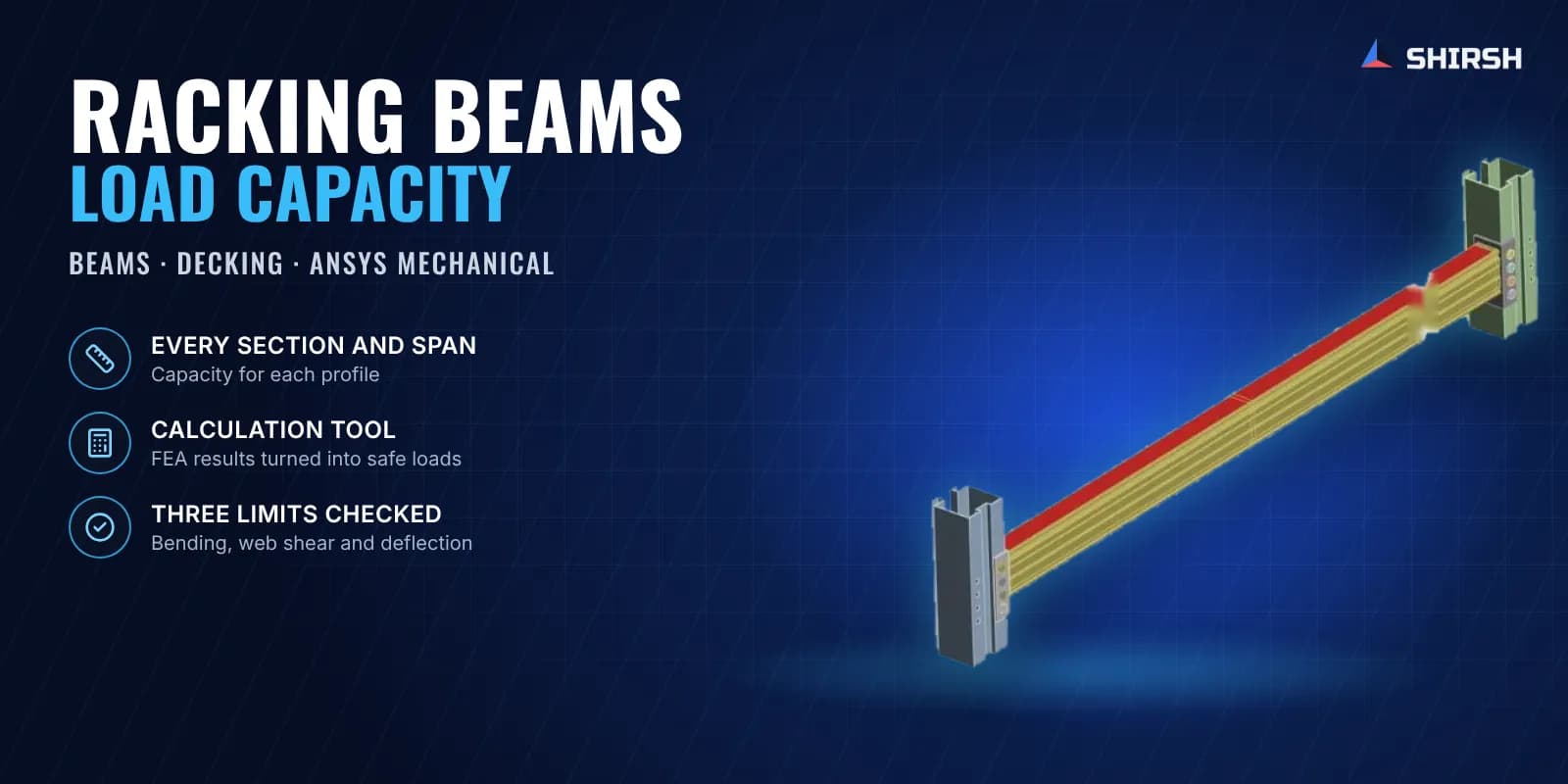
Project brief
A storage racking manufacturer needed a safe load capacity for every beam and decking panel in its range. The range covered several cross-section profiles, sheet thicknesses and spans, and each combination needed its own rating for the product literature and for customers' layouts.
Shirsh Technosolutions analysed the members in ANSYS Mechanical and built a calculation sheet that turns the FEA results into a safe capacity for each combination, with the governing limit recorded alongside it.
What was at risk
Taking every section, thickness and span to failure in a separate analysis would have taken far too long. Raw FEA output was also not enough by itself. A deflection at one point and a stress at another is not a load a sales engineer can quote.
Which limit decides the capacity changes with the section and the span, so deflection, bending stress and web shear stress all had to be checked every time. The method had to be quick to repeat and give ratings that compare like for like across the whole range.
Solution offered
For each section and span we ran a linear static analysis with a known reference load distributed along the beam. In the linear range, deflection and stress rise in direct proportion to the load, so one run gives everything needed to scale to any other load.
The calculation sheet takes the deflection, bending stress and web shear stress from the reference run and works out the load at which each one reaches its limit. The lowest of the three is the safe capacity, and the sheet notes which limit governed. Decking panels went through the same process.
Results were delivered as capacity tables and charts, so the client's team could read off a rating without going back to the analysis.
Common questions
Why scale from one reference load instead of loading each beam to failure? Within the linear range, stress and deflection are proportional to load. One run at a known load gives that proportion, and the load at each limit follows by simple ratio. Behaviour beyond that range, such as buckling or yielding, needs a separate nonlinear check.
Which limit usually governs a racking beam? It depends on the span and the section. Longer spans are more often limited by deflection and shorter, heavily loaded spans by stress. That is why the sheet checks every limit for every combination and reports the one that governs.
Challenges we overcame
Many combinations of section profile, thickness and span to rate
Turning FEA deflection and stress into a safe load that can be quoted
Checking deflection, bending and web shear for every combination
Keeping the method identical so ratings compare like for like
Stable solutions across very different section geometries
How we executed
- 1
Simplified each beam and panel to its load-carrying section
- 2
Built an FEA model for each section, thickness and span combination
- 3
Applied a known reference load distributed along the beam
- 4
Extracted deflection, bending stress and web shear stress
- 5
Worked out the load at which each limit is reached in the calculation sheet
- 6
Took the lowest as the safe capacity and recorded the governing limit
- 7
Issued capacity tables and charts for the full range
Project outcome
A safe load capacity for every beam section and span, and for the decking panels.
Each rating records which limit governs, so the client knows what to change if more capacity is needed.
The calculation sheet cut the time needed to rate each new combination.
Results were delivered as tables and charts the client's team could use directly.
Project gallery
Where this lives
At a glance
We apply the same rigour to every engagement
Let us show you what's possible for your product.