Automotive ComponentsHeavy Machinery & Industrial EquipmentHeavy Engineering

Structural FEA Analysis

Comprehensive finite element analysis services for structural integrity, fatigue life, and design optimization of industrial components and assemblies.
View Case Studies
Structural FEA Analysis
Overview

What this solution covers

Our structural FEA practice delivers simulation-driven design validation — from linear static checks through advanced nonlinear, fatigue, and dynamic analysis — enabling clients to reduce physical prototyping costs and achieve first-time-right designs.
The problem

Pain points we address

Physical prototypes fail during testing, causing project delays and cost overruns

Lack of in-house FEA expertise to validate designs against customer specifications

Uncertainty about fatigue life and long-term structural reliability under service loads

Designs are over-engineered due to insufficient understanding of actual stress distributions

Our answer

What we solve

Structural adequacy assessment against applicable design codes (ASME, EN, IS)

Fatigue life prediction under constant and variable-amplitude loading

Nonlinear contact, large deformation, and material plasticity analysis

Dynamic response evaluation — modal, harmonic, random vibration, and seismic

Methodology

Our approach, step by step

1
Geometry preparation: import native CAD from SolidWorks, perform defeaturing and mid-surface extraction for shell elements
2
Mesh generation: structured hex meshing for critical regions, automatic tetrahedral meshing with convergence studies
3
Boundary conditions: apply realistic constraints and loading from test data, load spectra, or code-specified combinations
4
Solution and post-processing: run ANSYS Mechanical solver with appropriate nonlinear controls, extract von Mises stress, fatigue damage, and safety factors
5
Reporting: deliver engineering report with methodology, assumptions, results interpretation, and design recommendations
What you get

Deliverables

  • FEA methodology document with assumptions and boundary condition rationale
  • Detailed results report with stress/deformation contour plots and safety factor mapping
  • Fatigue life report with damage fractions and critical location identification
  • Design improvement recommendations with supporting parametric study data
  • ANSYS Mechanical project files for client internal review and future reanalysis
Impact

Expected outcomes

Reduction in physical prototyping iterations by 40-60% through virtual testing

Design sign-off confidence backed by code-compliant FEA evidence

Weight reduction of 15-25% through stress-driven topology and parametric optimization

Accelerated development timelines by identifying failure modes early in the design cycle

Why us

Why Shirsh

Our engineers bring deep domain expertise in structural mechanics, material behavior, and industry code compliance. We don't just run simulations — we interpret results in the context of manufacturing feasibility, code requirements, and operational reality, delivering actionable engineering recommendations rather than raw contour plots.

Read more

Related insights

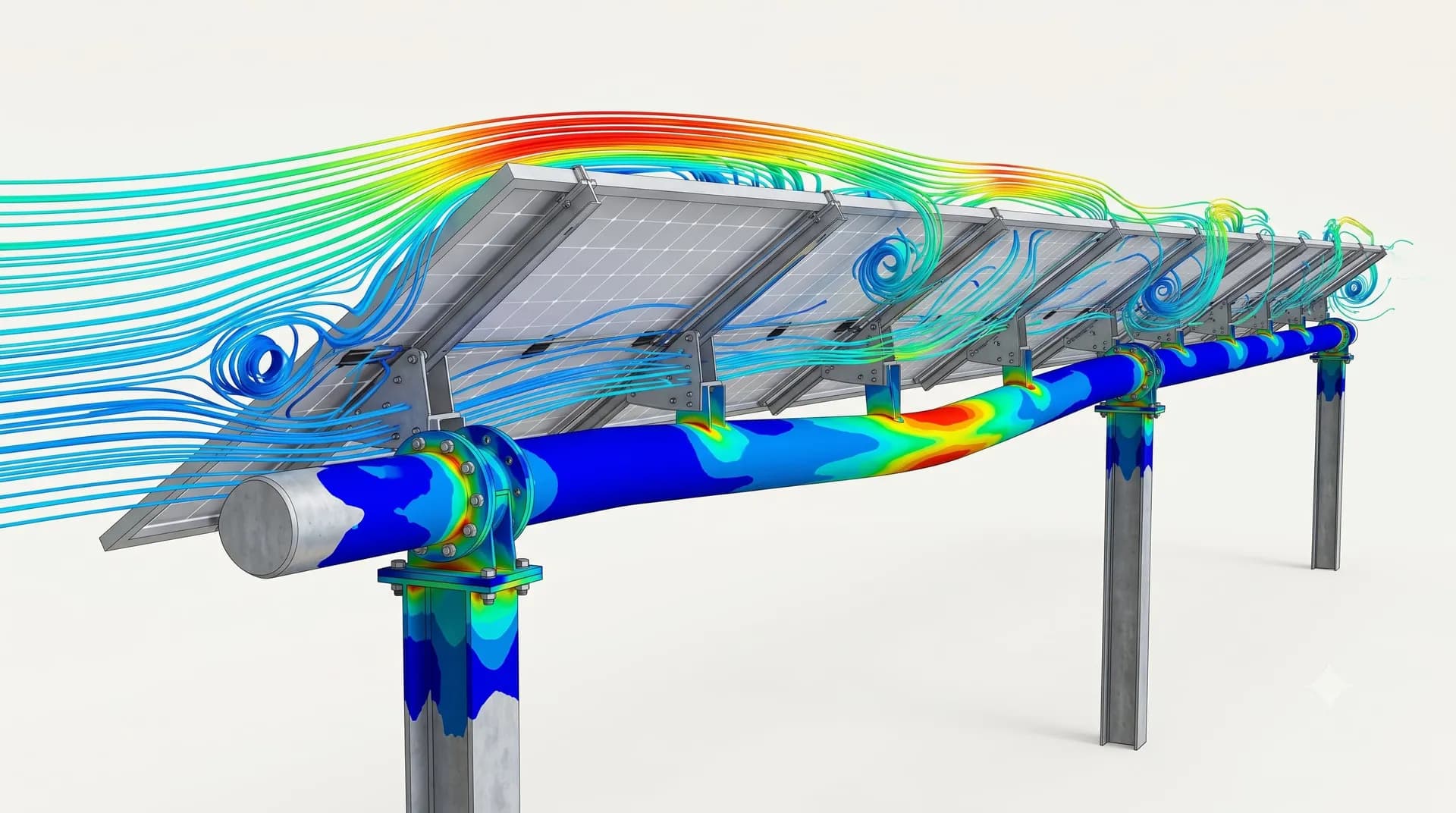
Why Single-Axis Solar Trackers Need FEA, CFD, and Aeroelastic Analysis — Not Just IS 875
A single-axis solar tracker can clear every line of IS 875, pass its STAAD model, and still fail in a windstorm that never reached the code design speed. The reason is uncomfortable but simple: the code hands you a static pressure, and the structure that tore apart was responding to a dynamic, fluid-structure problem the code was never written to see. This is sharpest with single-axis trackers, which behave less like a stiff steel frame and more like a bridge deck on a torsional spring. Here is where IS 875 stops, where FEA and CFD pick up, and why "passes the code" and "survives the wind" are two different questions.
Why Fixed-Tilt Ground-Mount Solar Structures Fail
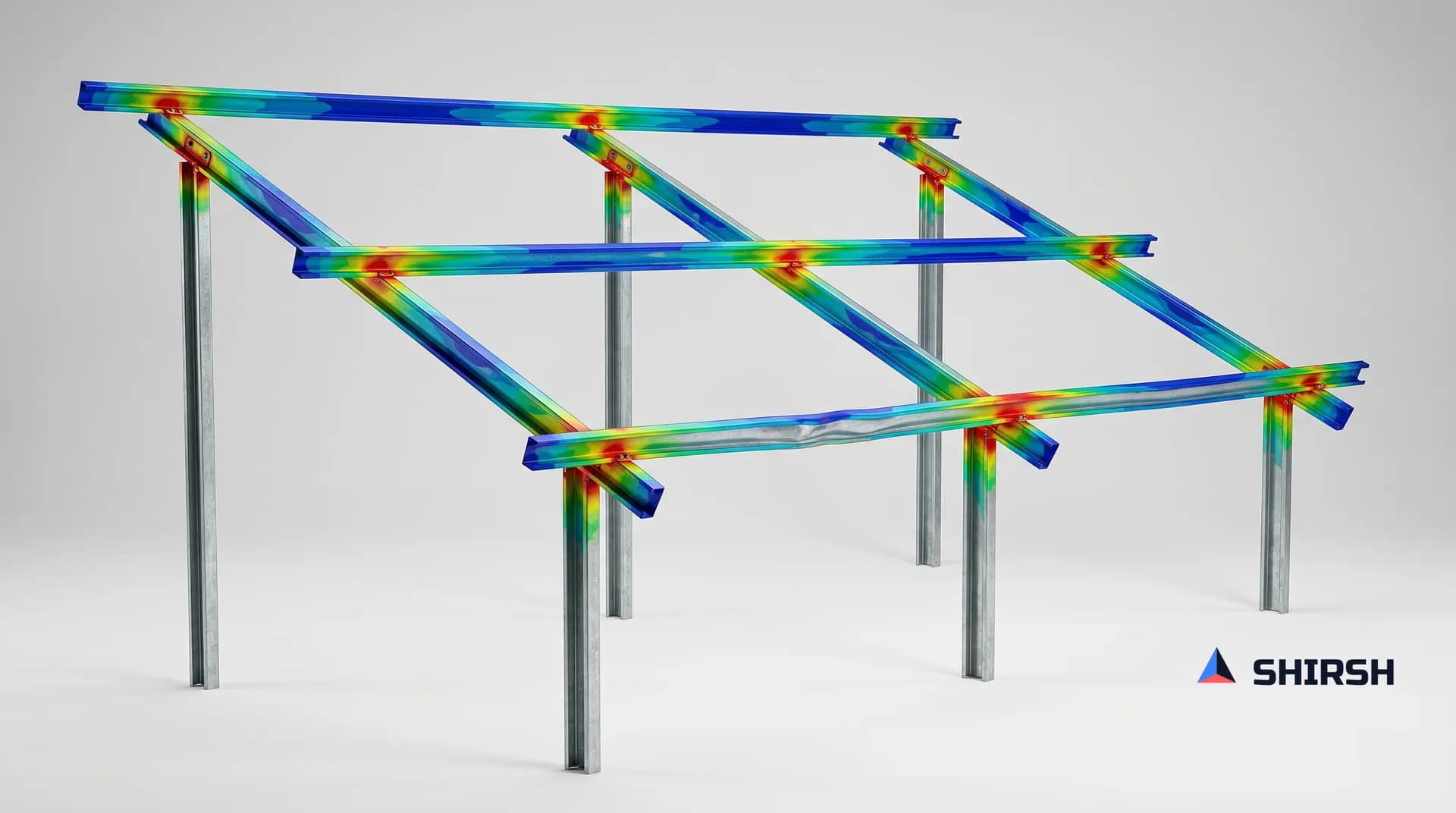
Fixed-tilt ground-mount is the structure everyone treats as solved. No moving parts, a straight load path from module to rail to post to ground, a static wind check, done. That reputation for simplicity is precisely why these structures fail — not from exotic physics, but from foundations pulled out of the soil, connections detailed for the wrong load direction, slender members that buckled under uplift, and corners that saw far more wind than a borrowed coefficient ever admitted. Walk the load path with a failed array in front of you and the causes are rarely mysterious. Here is how to read the damage, and the analysis chain that would have caught it on paper.
How to Check a Cold-Formed Solar Mounting Structure to IS 801: A Step-by-Step Guide
Most ground-mounted solar structures in India are made from cold-formed steel — thin steel sheet bent into channels and hat sections. Engineers find the wind load from IS 875 Part 3, then check the steel using IS 801. Two mistakes are very common. First, engineers use the full cross-section, but thin steel does not work that way — part of it buckles early, so the code makes you use only the "effective" part. Second, engineers check only the steady (static) load and skip the moving (dynamic) effects. This guide explains both problems in simple steps. It then checks the four main members of a solar structure — post, rafter, bracing, and a 1 mm hat purlin — with full numbers, so you can see exactly where the common shortcuts go wrong.
Want to learn this?

We also offer ANSYS & SolidWorks training courses

Browse Training Center

Ready to Solve This Challenge?

Tell us about your engineering problem — our team will propose a strategy tailored to your requirements.