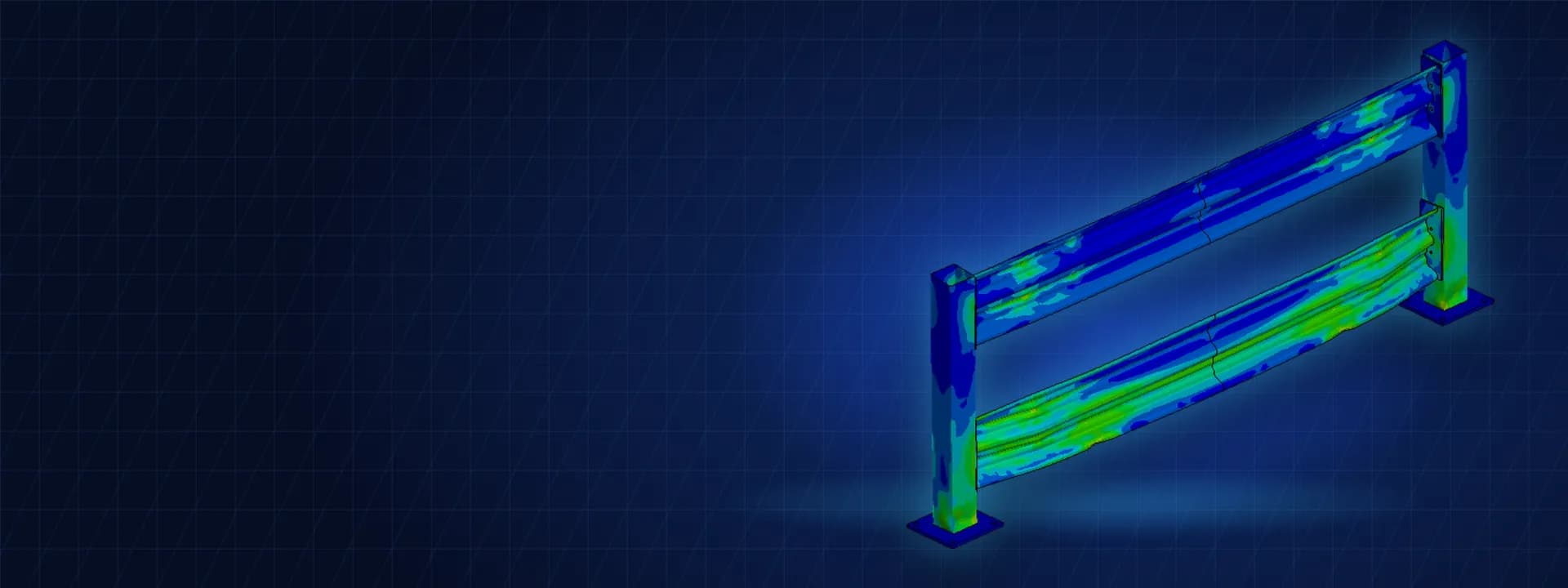
Forklift Impact Simulation of a Warehouse Guard Rail with Explicit Dynamics FEA
Explicit dynamics FEA of a warehouse guard rail hit by a loaded forklift, with real steel curves, to prove the rail and posts absorb the impact.
Project brief
A warehouse safety products manufacturer needed evidence that its anchored double-rail guard rail would stand up to a hit from a loaded forklift. The rail was going to an overseas distributor, who wanted an engineering report on the specific rail span and column combination it planned to sell.
Shirsh Technosolutions ran a full explicit dynamics crash simulation of the forklift striking the guard rail, using stress-strain curves built from the manufacturer's own mill test certificates. The report showed how the rails, posts and base plates take and absorb the impact, part by part, and gave the client a documented basis for the design before any physical crash testing.
What was at risk
A warehouse guard rail is a simple-looking product. Two formed steel rails are welded to end plates and bolted to square tube posts, and each post stands on a base plate anchored to the floor. In service, though, it is struck by a moving forklift, and that is a short, violent event where the steel goes well past yield and the parts slide and bear against each other.
A hand calculation or a static FEA with an equivalent force does not capture that properly. The client needed answers to a few specific questions:
whether the light-gauge formed rails could take the impact without tearing or collapsing
whether the posts and their bolted connections would hold, or fold over at the base
how much permanent deformation the rail would show after the hit
whether the base plate around the anchor bolts was adequate
The manufacturer had worked with us earlier on a longer rail span. This time the distributor asked for a shorter anchored span with a different column, and the report had to be written for that buyer.
Solution offered
A real crash event, not an equivalent load. We modelled the impact as it happens: a forklift carriage and forks moving at speed into the guard rail, solved with explicit time integration so the contact, large deformation and plasticity develop over the duration of the strike.
Full assembly modelled from the client's general arrangement drawings: formed rails, rail end plates, double-column posts and anchored base plates.
The forklift impacting face treated as rigid, which is the conservative choice because all of the impact energy has to be taken by the guard rail.
Base plates restrained at the four anchor bolt holes, rails welded to the end plates and bolted to the posts, as on site.
Frictional steel-to-steel contact between the parts, and self-weight included from material density.
A symmetric model to keep run time sensible without losing the behaviour at mid-span or at the posts.
Material curves from the client's own steel. The rails, posts and plates were each given an elastic-plastic true stress-strain curve, built from the yield, ultimate and elongation values in the mill test certificates the client supplied for the actual coil and tube used. The rail steel and post steel behave quite differently past yield, so a single generic curve would have given the wrong answer.
Results read the way a design reviewer needs them. For the full assembly and then for each part, we reported resultant displacement, von Mises stress and effective plastic strain, along with time histories of deformation and stress through the impact. An energy summary showed the forklift's kinetic energy being converted into internal energy in the guard rail, which is the check that the simulation is physically sound.
Common questions
Why use explicit dynamics for a guard rail impact and not a static FEA? A forklift strike lasts a fraction of a second and pushes the steel well beyond yield, with parts sliding and bearing on each other. Explicit dynamics follows that event step by step with contact and plasticity, so the deformation and the energy taken by each part come out directly instead of being guessed from an equivalent static force.
Does a crash simulation replace physical impact testing of a guard rail? Not where a buyer or standard asks for a physical test. The simulation shows where the rail and posts yield, how far they deflect and whether the connections hold, so the design can be settled and documented before the expense of test samples and a crash rig.
Challenges we overcame
A short, high-speed impact where the steel goes well past yield
Thin formed rails and heavier posts with very different plastic behaviour
Bolted and welded joints that have to transfer the load without letting go
Contact and sliding between the forklift, rails, end plates and posts
Material data that had to reflect the actual steel supplied, not a handbook value
A report written for an overseas distributor's engineering review
How we executed
- 1
Collected the guard rail general arrangement drawings, the rail and column details and the mill test certificates from the client
- 2
Built true stress-strain curves for the rail, post and plate steels from the certificate values
- 3
Modelled the full anchored double-rail assembly with the forklift carriage and forks as a rigid impactor
- 4
Defined the anchor bolt restraints, welded and bolted connections and frictional steel-to-steel contact
- 5
Applied the forklift mass and impact speed specified by the distributor and solved with explicit time integration
- 6
Checked the energy balance between kinetic and internal energy through the impact
- 7
Extracted displacement, von Mises stress and effective plastic strain for the assembly, the rails, the posts and the base plates
- 8
Issued an engineering simulation report with plots, time histories and a clear conclusion for the distributor
Project outcome
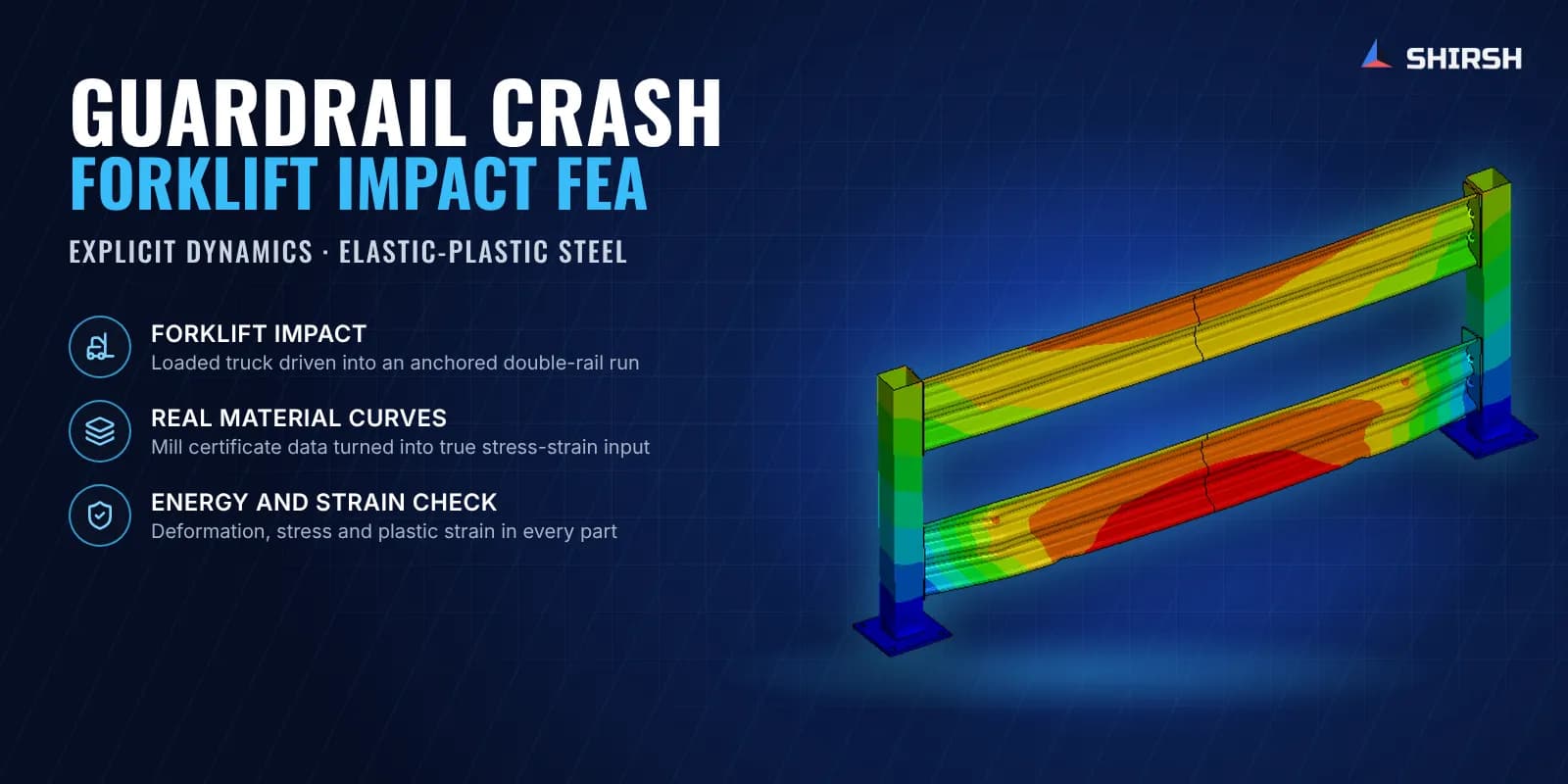
The guard rail absorbed the forklift impact, with the lower rail taking the largest share of the deformation at mid-span.
The report concluded that induced stresses and plastic strains in the rails, posts and base plates were within acceptable limits for the steels supplied.
Plastic strain in the rails stayed confined to small local zones, and the anchored base plates showed low stress around the bolt holes.
The manufacturer received an engineering simulation report for the exact rail and column combination its distributor wanted to sell.
Project gallery
Where this lives
Software used
Related solutions
Industries
At a glance
We apply the same rigour to every engagement
Let us show you what's possible for your product.