Why Fixed-Tilt Ground-Mount Solar Structures Fail: Reading the Damage, and the Analysis That Prevents It
Fixed-tilt ground-mount is the structure everyone treats as solved. No moving parts, a straight load path from module to rail to post to ground, a static wind check, done. That reputation for simplicity is precisely why these structures fail — not from exotic physics, but from foundations pulled out of the soil, connections detailed for the wrong load direction, slender members that buckled under uplift, and corners that saw far more wind than a borrowed coefficient ever admitted. Walk the load path with a failed array in front of you and the causes are rarely mysterious. Here is how to read the damage, and the analysis chain that would have caught it on paper.
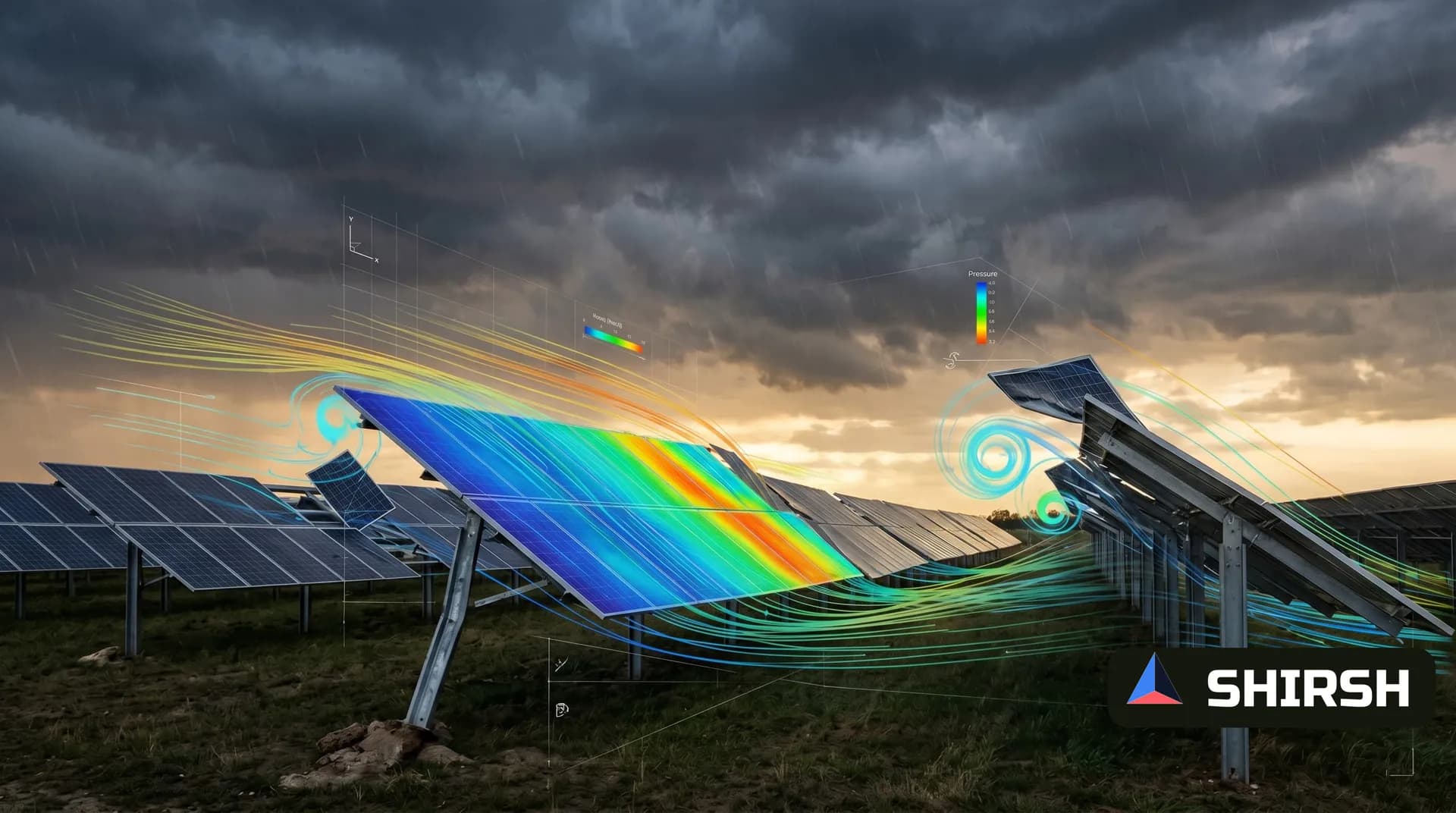
The trap of the "simple" structure
A fixed-tilt array has an honest, predictable load path. Wind and snow press on the modules, the load runs into the purlins, from the purlins into the posts, from the posts into the foundation, and from the foundation into the soil. Nothing rotates, nothing oscillates, the tilt never changes. Compared with a tracker — which behaves like a bridge deck on a torsional spring and can tear itself apart in moderate wind — the fixed-tilt frame really is the calm, well-behaved cousin.
And that is the trap. Because the load path is simple, the structure gets treated as a commodity: a standard cold-formed section, a standard pile, a wind pressure looked up from a table, a quick check for steady-state static loads, and a price war on steel weight. Two things get lost in that. First, these are cold-formed light-gauge members, so working-stress design to IS 801 governs and the steel fails by buckling, not by reaching yield — a different problem than the hot-rolled, limit-state world most people picture. Second, almost nobody checks the dynamic case; the structure is assumed rigid and the wind assumed steady, and the calculation stops at the steady-state peak. The physics is simpler, so the engineering attention shrinks to match. Then a storm arrives, or five years of weather pass, and the field tells a different story — rows leaning, posts heaved, panels gone, rust eating the ground line.
The failures are not subtle and they are not unpredictable. They live at specific links in that simple load path, and almost every one of them was visible in the calculation if anyone had looked hard enough. Let us walk the chain from the ground up.
The foundation: where most of the damage starts
Stand in front of a wind-damaged fixed-tilt array and the foundation is usually the first thing that gave way. There are a few distinct stories the damage tells.
Pile pullout under uplift. A tilted panel in wind is a lifting surface. The governing load case is not the panel weight pressing down — it is the wind pulling the whole assembly up. Because these structures are light cold-formed steel, the dead load that should help hold them down barely shows up: the net uplift is essentially the full wind uplift minus a few kilograms of steel and glass, and almost all of it drives straight into the foundation. A lighter, cheaper structure makes this worse, not better. If the pile embedment was sized off a generic table instead of the soil's measured pullout capacity, the pile simply walks out of the ground, and the row tips over intact — a tell-tale sign that the steel was fine and the anchorage was not.
Settlement and differential movement. Posts that have sunk to different depths, purlins that bow, modules out of plane — this is soil bearing failure, not steel failure. Expansive clays that swell and shrink with moisture, poorly compacted fill, a water table nobody accounted for: the soil moves, and the structure follows. Differential settlement also dumps unintended forces into connections that were never designed to take them.
Overturning. Whole tables tipped over, especially on the edges of the array, point to an overturning moment that beat the foundation's resisting moment. Edge and corner rows see the highest uplift, and a ballast or embedment depth sized for an interior row is not enough out there.
The hard truth about foundation failures is that they are the most expensive thing on this list to fix after the fact. You cannot easily re-drive a pile under a live, energized array. The place to solve this is the geotechnical investigation and the design, before the first pile goes in — and that is exactly the step that gets skipped to save time and money on "simple" projects.
The connections: detailed for the wrong day
When the foundation holds, the next weakest link is the joint. Sheared bolts, elongated bolt holes, popped module clamps, purlins separated from posts — these are connection failures, and they share a common root cause.
Most connections get detailed for the load case the designer pictured: gravity. Panels and snow pressing down, the joint in a familiar state. But the failure-day load is uplift, which reverses the direction of the force through the joint. A clamp or bracket perfectly adequate in compression can peel, pry, or shear when the load flips and tries to lift the purlin off the post. Module clamps are a particular weak point — they grip the laminate at discrete points, and under uplift those points concentrate prying forces that the global frame model never resolves.
A stick model of the frame reports member stresses and never sees this. The connection has to be analyzed as a connection — the bolt group, the bracket, the local bearing on the purlin — under the uplift case, not just the gravity case.
The members: cold-formed, buckling-governed, and checked the wrong way
Here is a fact that quietly shapes every fixed-tilt failure and that a lot of design treats casually: ground-mount MMS members are almost always cold-formed light-gauge steel — C, Z, hat, and omega sections rolled from thin sheet. That single material choice changes which code governs and how the steel actually fails.
Cold-formed members are designed in India to IS 801, and IS 801 is a working stress code. You check unfactored service loads against an allowable stress — yield divided by a factor of safety of roughly 1.67 — not the partial-factor limit-state machinery of IS 800 that hot-rolled steel uses. Designers who reach for IS 800 limit-state combinations on a cold-formed solar frame are applying the wrong method to the wrong steel. The distinction is not academic: the two routes handle the section, the safety margin, and the wind combination differently, and getting it wrong produces a number that looks fine and isn't.
More important is how thin cold-formed sections fail. Their strength is governed by buckling, not yield. A thin flange or web buckles locally — and in lipped channels, distortionally — well before the steel anywhere reaches its yield stress. IS 801 handles this through effective-width and form-factor reductions, which is to say the code already admits that the full cross-section does no work: only an effective portion of each thin element is counted. That is the whole reason a cold-formed section is sensitive in a way a chunky hot-rolled section is not.
Now add uplift, and the danger sharpens. Under gravity, the panel and purlins restrain the compression flange and the section is well-behaved. Under wind uplift the load reverses — the flange that was comfortably in tension is now in compression, and the restraint that was there under gravity may not be there in the uplift direction. The effective section, the unbraced length, and the buckling capacity all change for the worse precisely in the load case that governs. A check run only for gravity, or run without re-evaluating restraint and effective section under uplift, can be confidently wrong.
Bent rafters, kinked posts, and crumpled, locally-buckled purlins in the damage photos are this story. A linear static stress utilization that reads comfortable says nothing, because buckling is a stability problem, not a strength one. And IS 801 itself is a dated code — 1975 vintage, working-stress, and weak on distortional buckling compared with the modern Direct Strength Method that AISI and others now use. Even a correct IS 801 check can under-predict distortional modes. This is where shell-element FEA earns its place: it captures the local, distortional, and global buckling interaction that the code's effective-width formulas only approximate, and it does so for the actual restraint and load direction rather than an idealized one.
Corrosion: the slow failure nobody photographs on day one
Not every failure is a storm. A great many fixed-tilt structures are quietly failing over their 25-year life through corrosion, and the damage shows up years before the design life is reached.
The ground line is the killer. The zone where the post enters the soil sits in alternating wet and dry, holds moisture, and is where galvanizing gets scratched during driving — so that is where rust concentrates and the section thins. Above ground, the galvanic couple of an aluminium module frame, a galvanized steel purlin, and a stainless bolt is a classic dissimilar-metals problem; put them together without isolation in a humid or coastal site and the less noble metal corrodes preferentially at the interface. Coastal salt and industrial atmospheres accelerate all of it.
Corrosion is an engineering decision disguised as a procurement decision. The galvanizing thickness, the material pairing, the section's sacrificial allowance, and the detailing at the ground line all decide whether the structure reaches 25 years or quietly loses section until a normal gust finishes it.
The loads the code never charged you for
Underneath several of these failures is the same gap that haunts all solar wind design: the pressure coefficients.
IS 875 (Part 3) gives a clean framework for turning a site wind speed into a design pressure, but it carries no coefficients derived for a tilted, free-standing PV row sitting low to the ground with other rows around it. So designers borrow — a monoslope roof coefficient, a hoarding value — numbers measured for other shapes entirely. For the field interior, the borrowed value is often conservative. For the leading edges and corners, it can badly undercount the real uplift, which is exactly why edge and corner rows fail first.
There is also a dynamic component people assume belongs only to trackers. Even a rigid fixed-tilt array sheds vortices off its panel edges, and that shedding produces fluctuating, dynamic uplift that depends on tilt angle, ground clearance, row spacing, and how far the post sits back from the panel edge. It is not the runaway instability a tracker suffers, but it amplifies the peak loads above the steady value a single static coefficient predicts.
The static-only habit: checking the easy half of the problem
This is the gap worth naming on its own, because it is the most common one. Almost every fixed-tilt MMS is checked for steady-state conditions only — one peak wind pressure applied as a static load, allowable stresses verified, done. The structure is treated as rigid and the wind as constant. Neither is true, and three dynamic realities get left out of the calculation entirely.
The first is the fluctuating uplift from the vortex shedding above. Wind on a bluff inclined plate is not a steady push; it pulses, and the peaks ride well above the mean a static coefficient captures.
The second is the structure's own dynamic response. A light, flexible cold-formed frame can have surprisingly low natural frequencies, low enough to sit inside the energy of natural wind gusts. When that happens the structure amplifies the load through its own vibration — a dynamic amplification a static check cannot produce by definition. IS 875 (Part 3) does contain a gust-factor method meant for exactly this kind of flexible structure, but standard MMS practice rarely invokes it, because the structure was assumed rigid from the start.
The third, and the quietest, is fatigue. Wind delivers millions of load cycles over 25 years, and cold-formed steel with its thin sections and its screwed and bolted connections is unusually fatigue-sensitive — the stress concentrations at holes and at clamp points are exactly where cracks start. A static check that passes comfortably says nothing about whether a connection survives a decade of cyclic loading. Fatigue is invisible to steady-state analysis, and it is a real way these structures reach end of life early.
A design that treats the array as one uniform static pressure on a rigid frame misses all of this: the spatial concentration at the edges, the dynamic amplification, and the slow accumulation of fatigue. Checking the steady-state case is checking the easy half of the problem.
The analysis chain that would have caught it
None of these failures requires exotic tools to prevent. It requires running the whole chain instead of stopping at the first static check.
Site-specific wind loads. CFD computes the pressure and uplift for the actual array — the real tilt, ground clearance, row spacing, and crucially the difference between an interior row and an exposed edge or corner row — instead of stretching a borrowed coefficient over the whole field. For a utility-scale plant, getting the edge-row coefficients right is the difference between a perimeter that survives and one that peels off in the first storm.
Structural analysis done for the right steel and the right load case. Cold-formed members get checked to IS 801 working-stress, not borrowed limit-state combinations, and the check is run for the uplift case with restraint and effective section re-evaluated for the reversed load — not just gravity. Shell-element FEA catches the local and distortional buckling that the code's effective-width formulas only approximate, and the connections — purlin-to-post, module clamps — get analyzed as connections under load reversal, not read off a frame stress plot.
The dynamic case, not just the static one. This is the step most often skipped. A modal analysis tells you the structure's natural frequencies and whether wind gusts can excite them; a gust dynamic check captures the amplification a rigid static model cannot; and a fatigue assessment of the connections accounts for the millions of cycles a 25-year life delivers. For a light cold-formed frame these are not optional refinements — they are where the real margin, or the lack of it, sits.
Geotechnics integrated, not assumed. The structural uplift and shear reactions are only half the equation; the other half is what the soil can actually resist. Pile embedment sized against measured pullout capacity, foundation type matched to the real soil — driven pile, helical, ballast, screw — bearing capacity and settlement checked, the water table and expansive-soil behaviour accounted for. The structural and geotechnical sides have to be solved together, because the foundation is where the two meet and where most of the failures live.
Durability designed in. Galvanizing and material pairing chosen for the site's corrosivity, the ground line detailed deliberately, dissimilar metals isolated. This is a design choice, and treating it as one is what gets the structure to its design life.
Reading a failure after the fact
When the structure has already failed — and you have the photos — the same chain runs in reverse as a forensic exercise. The damage pattern points to the link that gave way first. A row tipped over intact says foundation pullout. Posts at varying heights say settlement. Sheared clamps with the members intact say a connection detailed for the wrong load direction. Rust-thinned sections at the ground line say a corrosion and detailing problem. Edge rows gone while the interior stands says the wind loads were uniform on paper but not in reality.
Pairing the damage with the as-built drawings, the site wind data, and a back-analysis tells you not just what failed but why — and that is what separates a remediation that fixes the real problem from one that rebuilds the same failure. For an owner staring at a damaged field, that root-cause answer is the thing worth having before spending money on repairs.
Where this is heading
The hardware keeps moving the target. Modules are getting larger and heavier, ground clearances are rising to suit bifacial gains, and bigger panels mean bigger lifting surfaces and higher loads through the same slender frames. Sites are getting harder, too — more projects on slopes and marginal soils as the easy flat land fills up, which pushes the geotechnical problem to the front.
The standards are catching up unevenly. Codes elsewhere have added solar-specific, array-aware wind provisions; IS 875 still has no dedicated treatment for ground-mount PV, so Indian projects lean on borrowed coefficients or imported practice. Until that gap closes, project-specific CFD is how serious utility-scale designs get the real numbers.
On the analysis side, CFD-derived site-specific coefficients are becoming routine for large plants rather than a luxury, GPU solvers are making them fast enough to fit a project schedule, and the inspection side is changing just as fast — drone photogrammetry and image-based defect detection are turning the after-the-fact failure photo into a quantitative input, so a damaged field can be surveyed and back-analyzed far more cheaply than before. Condition monitoring that tracks real wind exposure against a structure's fatigue budget is the next step, moving owners from reactive repair toward predicted maintenance.
Where projects get stuck, and where we help
The pattern is consistent: the structure gets designed as a commodity against a borrowed wind coefficient with a static check, the geotechnical work gets thinned to a generic pile table, the connections get detailed for gravity, corrosion gets treated as a purchasing line item — and the failures show up in the field at exactly those skipped steps.
This is the work Shirsh does, on both sides of a failure. Before construction, we run the full chain: CFD for site-specific wind loads that distinguish edge and corner rows from the interior, structural FEA that covers the uplift case, buckling, connection details under load reversal, and fatigue, and geotechnical integration that sizes the foundation against the soil's real capacity rather than a table. After a failure, we read the damage — pairing your site photos and as-built data with back-analysis to find the actual root cause and the remediation that fixes it instead of repeating it. The deliverable in both cases is the same kind of honest answer: not "it passes the code," but where this structure is weak, what load or what soil or what detail will take it down, and what to change.
If you have a fixed-tilt site that has shown distress the design never predicted, or you are about to build one and want the foundations and edge rows right before the first pile is driven, that gap between "simple, so it's fine" and "actually engineered for the worst day" is where we work.
Shirsh TechnoSolutions provides FEA, CFD, and structural-geotechnical consultancy for solar and energy infrastructure. For ground-mount structure design, site-specific wind load studies, and failure investigation, get in touch.
Want to Apply This to Your Product?
Our engineers can help you implement these techniques on your specific components and assemblies.
Get insights like this in your inbox
Engineering deep-dives, simulation tips, and industry analysis. No spam, unsubscribe any time.