NFPA 855 (2026): Why Deflagration Venting Alone No Longer Covers BESS
The 2026 edition of NFPA 855 no longer lets deflagration vent panels carry a BESS explosion control design on their own. We summarise what the published reviews say changed and run a quick check on a 20 ft container to show why the average gas concentration is not the whole story.
Read the full article below for the methodology, the data, and the engineering decisions behind it.
For the last two editions, a BESS designer facing NFPA 855's explosion control clause could pick a route. Keep the flammable gas below 25% of its lower flammable limit with ventilation to NFPA 69, or let it burn safely through deflagration vents sized to NFPA 68. Vent panels were an attractive choice because they are passive and need no power.
The 2026 edition changes that choice. This note summarises what the published reviews of the new text say, and then runs a small check on a 20 ft container to show why the committee moved the way it did.
1. What changed in the 2026 edition
Three independent reviews of the 2026 edition agree on the main point. Exponent writes that NFPA 68 deflagration venting is no longer permitted as a primary explosion control strategy, and that installations need an explosion control and prevention system designed to NFPA 69 or a performance-based alternative backed by installation-level fire and explosion testing. Risk Logic says the same and adds that a listed continuous gas detection system has to activate the combustible concentration reduction (CCR) system at no more than 10% LFL, with the CCR system keeping the gas at or below 25% LFL on average. Code Red Consultants places the requirement in section 9.7.6.7 and notes that NFPA 68 venting, which was acceptable on its own in the 2023 edition (section 9.6.5.6), now has to come with an NFPA 69 CCR system.
The same review lists the other new demands. The trigger is now worded as the average vented gas concentration in the enclosure. Because local pockets above 25% LFL are likely to exist even when the average is below it, a partial volume deflagration analysis to NFPA 68 is expected. Gas must not migrate between interconnected enclosures. The NFPA 69 system has to be shown to work during a thermal runaway event, it is treated as a critical safety system with commissioning to NFPA 3 and integrated testing to NFPA 4, and its power supply falls under NFPA 110 or NFPA 111. Where a non-water suppression system is fitted, a study of its discharge sequence has to go to the authority having jurisdiction.
We have worked from these published reviews, not the standard itself. Anyone signing off a design should read sections 9.7.6.7 and 9.7.4 in the 2026 text.
Item | 2023 edition (as described in the reviews) | 2026 edition (as described in the reviews) |
|---|---|---|
Explosion control route | NFPA 69 prevention or NFPA 68 venting | NFPA 69 CCR required; NFPA 68 venting not permitted as the primary strategy |
Trigger | Gas able to exceed 25% LFL | Average vented gas concentration able to exceed 25% LFL |
Gas detection | Not stated in the reviews | Listed continuous detection starts CCR at no more than 10% LFL |
Local pockets | Not stated in the reviews | Partial volume deflagration analysis to NFPA 68 |
Interconnected enclosures | Not stated in the reviews | No gas migration between enclosures |
System status | Not stated in the reviews | Critical safety system: NFPA 3 and NFPA 4 testing, NFPA 110 or 111 power |
2. A quick check on a 20 ft container
To see what the new wording means in numbers, we took the container from our earlier Insight on BESS container gas venting: 21 m³ of free air, an exhaust fan of 0.25 m³/s and a hydrogen release of 1 L/s. Hydrogen's LFL is 4% by volume, so 25% LFL is 1% and 10% LFL is 0.4%. In this run we solved the single-zone mass balance, which assumes the gas is perfectly mixed through the free volume, for three situations.
With the fan running, the average settles at 0.398% hydrogen, which is 9.96% LFL, with a time constant of 84 s. That is comfortably inside the 25% LFL design limit. It is also just below the 10% LFL detection setpoint, so a detector that saw only the average would not start the CCR system at all.
With no ventilation, the average passes 25% LFL after 211 s and reaches 100% LFL after 857 s. If the fan runs for 10 minutes and then stops while the release continues, the margin from fan stop to 25% LFL is 127 s, and to 100% LFL it is 774 s. Two minutes is not much time, and it explains why the 2026 edition treats the CCR fan and its power supply as a critical safety system.
The same balance gives the airflow the average criterion needs. For a 1 L/s hydrogen release, 0.099 m³/s holds the average at 25% LFL, and 0.249 m³/s holds it at 10% LFL.

Figure 1. Single-zone check computed for this note. With the fan running the average settles at 9.96% LFL. Without the fan, 25% LFL is reached in 211 s; after a fan stop at 10 minutes, in 127 s.
3. Why the average is not enough
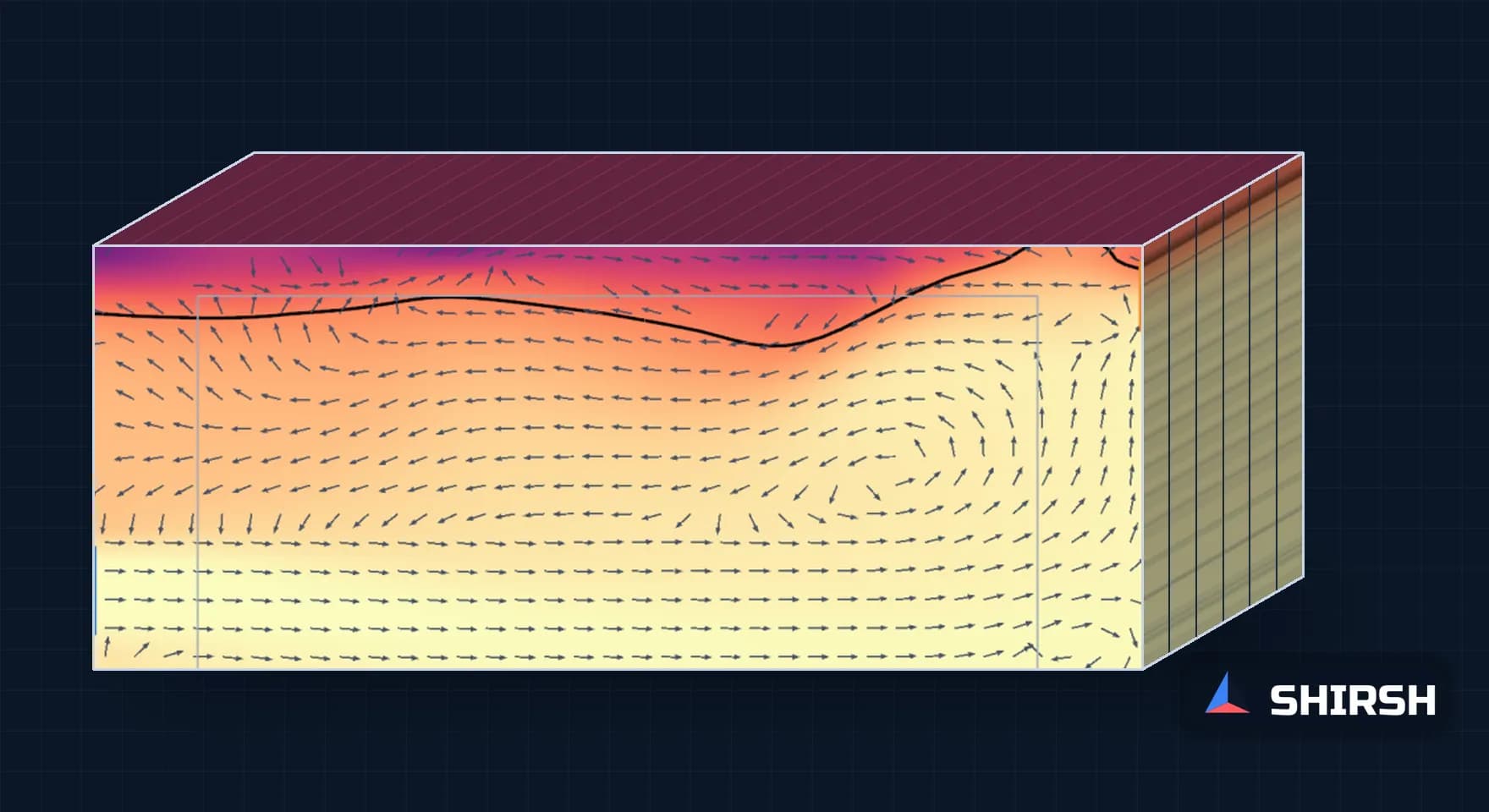
A well-mixed number says nothing about where the gas actually is. Hydrogen rises, and in a container the released gas tends to collect under the roof. If the same amount of gas sat only in the top fifth of the free volume, the 9.96% LFL average would become about 49.8% LFL in that layer. In the top tenth it would be 99.6% LFL, close to the flammable limit.
The CFD runs in our earlier Insight show this happening in practice. With exactly the same container, fan and release, the ceiling layer averaged 47.1% LFL with the fan high at the far end (case A at 900 s) and 238.6% LFL with the fan low at the far end (case B at 30 minutes, still rising). Moving the fan high above the louvre brought the ceiling layer down to 9.9% LFL (case C), and moving the release changed it to 16.9% LFL (case D). In case A, 20.5% of the free volume was above 25% LFL while the single-zone estimate said 10% LFL everywhere.

Figure 2. Same container and release. The single-zone average (computed here) against the ceiling-layer averages from the OpenFOAM cases in our earlier Insight. Cases A, C and D are at 900 s; case B at 30 minutes and still rising.
This is the reason the 2026 edition asks for a partial volume deflagration analysis even when the CCR system meets the average criterion. It also matters for detection. Where the detector sits decides whether the 10% LFL setpoint is reached early, late or never.
4. What a design submission now needs
For an NFPA 69 CCR design under the 2026 edition, the reviews point to evidence of the following kind. Gas volume and composition come from UL 9540A testing, which also feeds the mixture LFL. The airflow needs to be justified against the average criterion and, separately, checked for local accumulation, which is where a transient CFD study of the actual enclosure layout earns its place. Detector positions need to follow the predicted gas path. The fan, controls and power supply need to be shown to work during thermal runaway and when normal power is lost, and the design has to show that gas cannot move from one enclosure into the next.
Deflagration vent panels are not banned. They remain useful as a second layer, and the partial volume analysis is done to NFPA 68. They just no longer carry the design on their own.
Where Shirsh fits
At Shirsh Technosolutions we carry out transient gas dispersion CFD for BESS containers and enclosures with OpenFOAM and ANSYS Fluent, using the UL 9540A gas data as the source term, and we check fan position, detector placement and fan-failure scenarios against the NFPA 69 criteria. If you are moving a container design from the 2023 to the 2026 edition of NFPA 855, please get in touch.
References
NFPA 855, Standard for the Installation of Stationary Energy Storage Systems, 2023 and 2026 editions (section numbers as quoted in the reviews below).
Code Red Consultants, "Explosion Control and Prevention Updates in the 2026 Edition of NFPA 855".
Exponent, "NFPA 855 Expands Safety Guidelines for Battery Energy Storage Systems", 27 March 2026.
Risk Logic, "NFPA 855 (2026): Notable Changes to Stationary Battery Energy Storage Systems (BESS)", July 2026.
Shirsh Technosolutions, "BESS Container Gas Venting: What CFD Adds to NFPA 69 Ventilation" (source of the container inputs and CFD case results).
Well-mixed calculation: fe/calc_wellmixed.py, run 29 October 2026.
Click to view full size
Related case studies
Want to Apply This to Your Product?
Our engineers can help you implement these techniques on your specific components and assemblies.
Get insights like this in your inbox
Engineering deep-dives, simulation tips, and industry analysis. No spam, unsubscribe any time.