ASHRAE 241 Clean Airflow: What the Well-Mixed Number Leaves Out
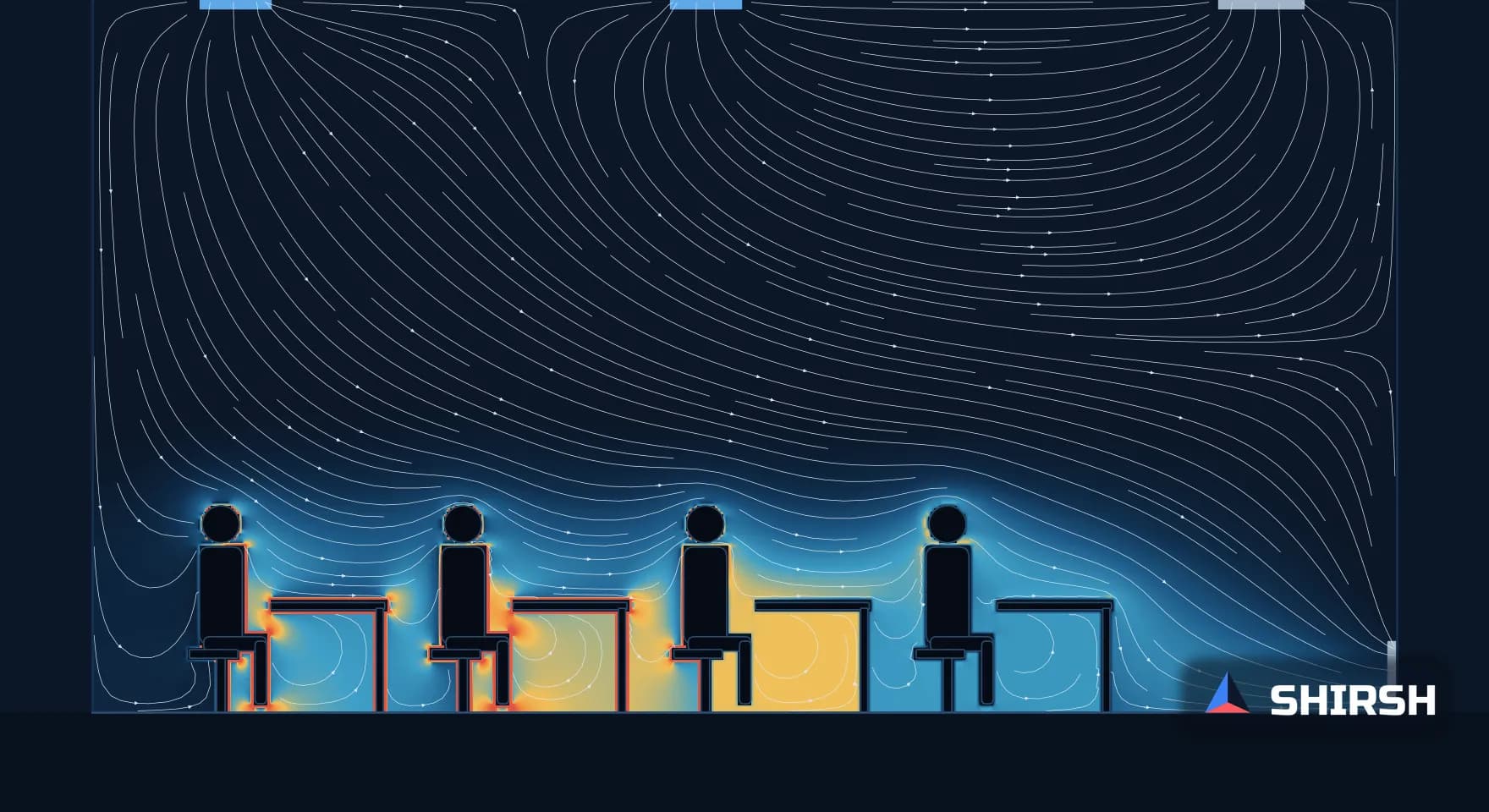
ASHRAE Standard 241 sets clean airflow targets per person and counts outdoor air, filtration and air cleaners towards them, on the assumption that the room is well mixed. For a generic 30-person classroom that means 1,200 cfm of equivalent clean airflow, 810 cfm of it from filtration, and 1,500 cfm at the diffusers if warm air from the ceiling gives an Ez of 0.8.
Read the full article below for the methodology, the data, and the engineering decisions behind it.
ASHRAE Standard 241, Control of Infectious Aerosols, was approved in June 2023 and is now the document many owners point to when they ask whether a classroom or an office floor has "enough clean air". Its central quantity is the equivalent clean airflow, ECA, and its targets are written per person.
The number is easy to compute and easy to check on paper. This note looks at what goes into it, works it through for a generic classroom, and then asks the question the standard itself leaves open: whether the clean air actually reaches the people breathing it.
1. What the standard asks for
ECA is the flow of pathogen-free air that, distributed uniformly in the breathing zone, would have the same effect on infectious aerosol concentration as everything the space really has. Three things add up to it: outdoor air, recirculated air passed through a filter, and air treated by air cleaners or other inactivation devices. For the filter path the credit is the flow multiplied by the filter's removal efficiency, so 1,000 cfm through a filter that removes half the infectious particles counts as 500 cfm of clean air.
Mechanical filters earn credit only at MERV-A 11 or better, with plain MERV 11 accepted until 1 January 2025. The efficiencies used come from the ASHRAE 52.2 test curve weighted by the size distribution of infectious aerosol, not from a single particle size. Air cleaners are credited on tested performance.
The targets apply in Infection Risk Management Mode, the operating mode in which the measures written into the building readiness plan are active. Outside that mode the normal ventilation design applies.
2. How big the per-person targets are
The standard's ECAi table covers 25 space types in 7 occupancy categories, from 20 to 90 cfm per person, with values doubled where occupants vocalise loudly. Three of them, compared with the default outdoor air per person under ASHRAE 62.1, show how far the targets sit above ordinary ventilation.
Space | Standard 241 ECAi, cfm per person (L/s) | 62.1 default outdoor air, cfm per person (L/s) | Ratio |
|---|---|---|---|
Office | 30 (14.2) | 17 (8.0) | 1.76 |
Classroom | 40 (18.9) | 13 (6.1) | 3.08 |
Restaurant | 60 (28.3) | 10 (4.7) | 6.00 |

ECAi targets from Standard 241 against the 62.1 default outdoor air per person for the same spaces, as presented at the 2023 Westford Symposium on Building Science. The ratio shows how much of the target has to come from filtration or air cleaning if outdoor air stays at the 62.1 rate.
Nobody expects a restaurant to bring in six times its outdoor air. The standard is built so that the difference comes from filtration and air cleaning, which cost far less energy per unit of clean air.
3. A worked check on a generic classroom
Take a 1,200 ft² (111 m²) classroom with 30 occupants, the default occupancy listed for this room size in an ASHRAE Journal comparison, and assume a 10 ft (3.05 m) ceiling, which gives 12,000 ft³ (339.8 m³).
ECA required: 30 × 40 = 1,200 cfm (566.3 L/s).
Outdoor air at the 62.1 default: 30 × 13 = 390 cfm (184.1 L/s).
Gap to be filled by filtration or air cleaners: 810 cfm (382.3 L/s).
How much recirculated air that takes depends entirely on the removal efficiency of the filter path. At an assumed efficiency of 0.5 the room needs 1,620 cfm through the filter; at 0.9 it needs 900 cfm; at 0.3 it needs 2,700 cfm. These efficiencies are illustrative inputs, not values for any MERV rating, and a real design would use the efficiency the standard assigns to the filter actually installed.
In a well-mixed room the steady concentration from a constant source is inversely proportional to the clean airflow. Moving from 390 cfm of outdoor air to the full 1,200 cfm of ECA brings it down to 0.325 of the outdoor-air-only level. The time constant drops from 30.8 to 10.0 minutes, so the room reaches 95% of its new steady state in 30 minutes instead of 92 minutes. In air-change language, 1.95 becomes 6.0 equivalent clean air changes per hour.

Left: filtered recirculation needed to cover the 810 cfm gap in the generic classroom, for assumed single-pass removal efficiencies. Right: ECA to supply if the 62.1 zone air distribution effectiveness were applied to the 1,200 cfm target. Computed for this note; well-mixed model.
4. The part the number does not cover
Every figure above assumes that the clean air mixes evenly and reaches the breathing zone. The standard's own authors acknowledge this. William Bahnfleth's 2023 presentation of Standard 241 lists air distribution as an important but difficult topic and notes that the standard "does not yet address ventilation/contaminant removal effectiveness".
ASHRAE 62.1 has handled the same problem for outdoor air for years through the zone air distribution effectiveness, Ez, in Table 6-2 of the 2010 edition. The outdoor air delivered to a zone is the breathing zone requirement divided by Ez. The table values are blunt but well known.
Air distribution (62.1-2010, Table 6-2) | Ez | ECA to supply for 1,200 cfm in the breathing zone | Breathing zone concentration at 1,200 cfm supplied |
|---|---|---|---|
Floor supply of cool air, ceiling return, low-velocity displacement | 1.2 | 1,000 cfm (472 L/s) | 0.83 of target |
Ceiling supply of cool air | 1.0 | 1,200 cfm (566 L/s) | 1.00 of target |
Ceiling supply of warm air 15 °F (8 °C) or more above space, ceiling return | 0.8 | 1,500 cfm (708 L/s) | 1.25 of target |
Floor supply of warm air, ceiling return | 0.7 | 1,714 cfm (809 L/s) | 1.43 of target |
Makeup air drawn in near the exhaust or return | 0.5 | 2,400 cfm (1,133 L/s) | 2.00 of target |
Standard 241 does not tell anyone to apply Ez to ECA, and this table is our reading, not a requirement. It does show the size of what is being left out. A classroom heated with warm air from ceiling diffusers and ceiling returns, a common arrangement in winter, would need 1,500 cfm of ECA at the diffusers to put 1,200 cfm into the breathing zone. A portable air cleaner parked beside the return grille can be worse, because much of its clean air goes straight back to the return. Note 5 of the same table allows Ez to be replaced by an air change effectiveness measured to ASHRAE 129, which is one honest way to close the gap on site.
5. Where CFD earns its place
For most rooms the Ez table and a sensible layout are enough. A model becomes worth the effort when the room is large or tall, when portable air cleaners are being placed by guesswork, when partitions or high-backed furniture split the breathing zone, or when the heating and cooling seasons give very different supply temperatures. A CFD study can show the age of air or a tracer concentration across the breathing zone for each season and each air cleaner position, and it gives a number for distribution effectiveness that the ECA arithmetic can then use.
The check we would want in any Standard 241 compliance note is short: the ECAi used and its source table row, the efficiency credited to each filter and air cleaner, the occupancy, and a stated assumption about distribution, either Ez from the 62.1 table, a measured air change effectiveness, or a CFD result.
Where Shirsh fits
At Shirsh Technosolutions we model room air distribution, air cleaner placement and contaminant dilution with ANSYS Fluent and OpenFOAM, for classrooms, offices, clinics and laboratories. If you are working towards Standard 241 and want to know whether the clean air you are paying for reaches the occupants, please get in touch.
References
ANSI/ASHRAE Standard 241-2023, Control of Infectious Aerosols, approved June 2023 (ECA definition, filter credit, Infection Risk Management Mode, building readiness plan, ECAi table), as presented in W. Bahnfleth, "ASHRAE's New Standard 241: Control of Infectious Aerosols", 25th Westford Symposium on Building Science, 31 July 2023 (slides 15, 16, 21 to 24 and 28: ECAi of 30, 40 and 60 cfm per person against 62.1 defaults of 17, 13 and 10; 25 space types, 20 to 90 cfm per person; MERV-A 11; distribution effectiveness not yet addressed).
B. Bruns, ASHRAE Journal column on Standard 241, October 2023 (default classroom of 1,200 ft² and 30 occupants; definition of Infection Risk Management Mode).
ANSI/ASHRAE Standard 62.1-2010, Ventilation for Acceptable Indoor Air Quality, Table 6-2 Zone Air Distribution Effectiveness and note 5.
Worked check computed for this note on 15 November 2026: well-mixed single-zone model of a generic classroom, assumed 10 ft ceiling and illustrative filter efficiencies. Not any project.
Click to view full size
Related case studies


Want to Apply This to Your Product?
Our engineers can help you implement these techniques on your specific components and assemblies.
Get insights like this in your inbox
Engineering deep-dives, simulation tips, and industry analysis. No spam, unsubscribe any time.