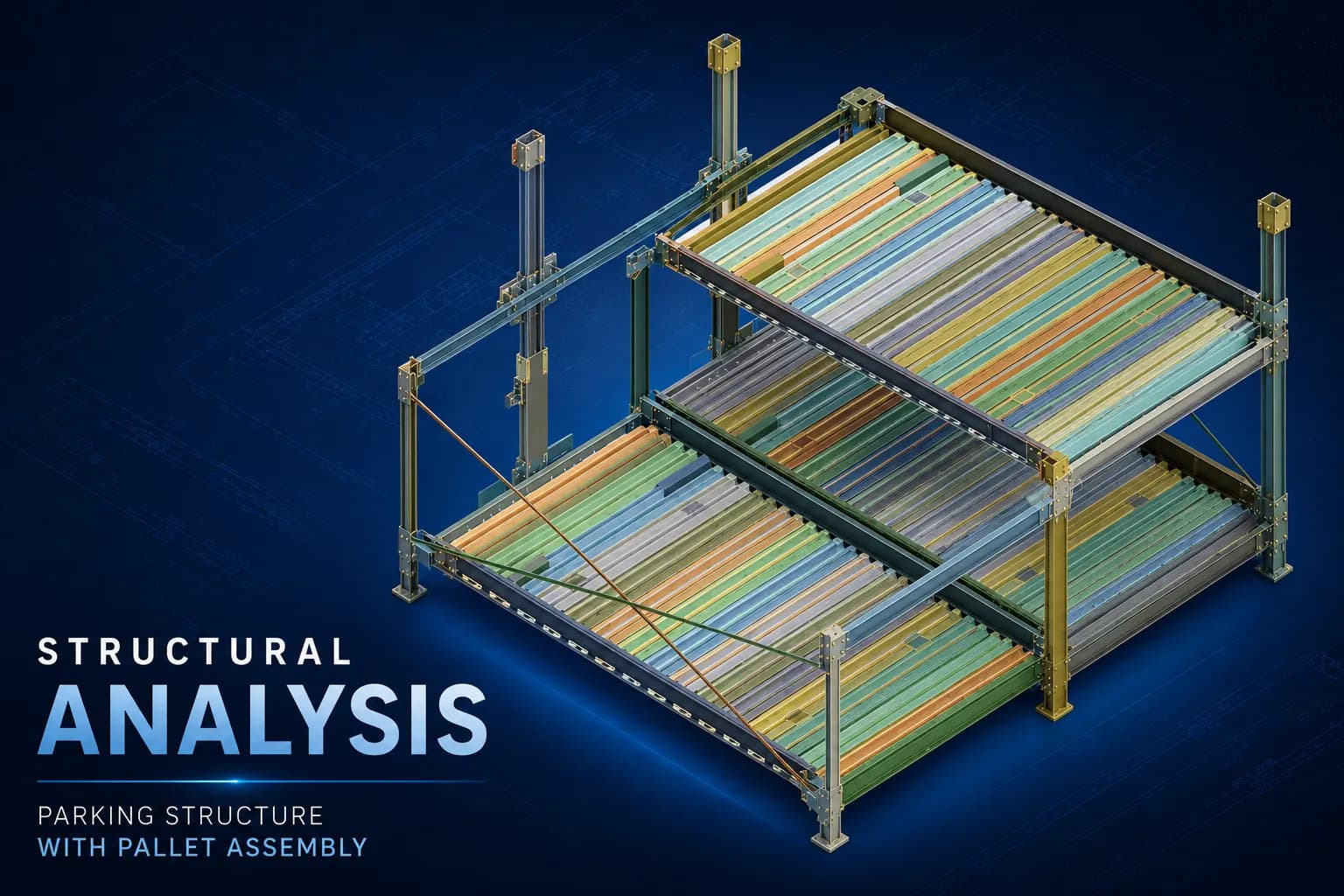
Structural Adequacy of the Total Structure with Pallet Assembly
Analyzing the stack parking system structure, necessitating modifications to achieve required safety factors.
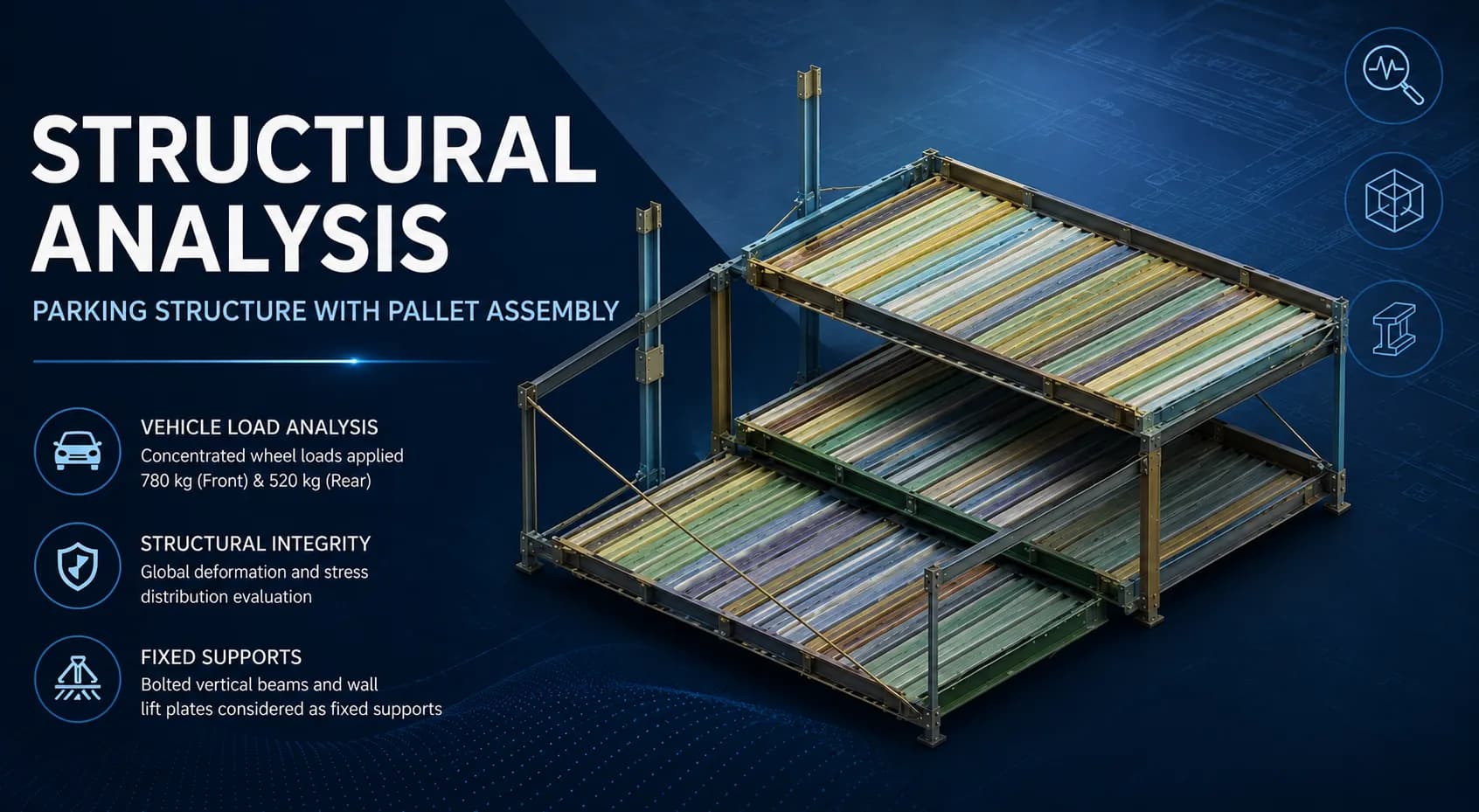
Project brief
A company specializing in stack parking systems, faced challenges ensuring the structural integrity of their pallet assemblies. The cost of structural failure in such systems includes potential equipment damage, warranty claims, and downtime, making it essential to ensure robust design.
Our task was to evaluate the structural adequacy of the entire assembly under vehicle loads. A key commercial stake was reducing potential failure costs, by ensuring that the system could withstand operational loads without failure.
What was at risk
The primary engineering challenge was to ensure that the structure with pallet assembly could support the loads imposed by parked vehicles. This included addressing concentrated wheel loads that varied between front and rear wheels.
Solution offered
After solving the simulation vertical members were identified as potential failure points under operational loads. So we did geometric modifications wherever needed, to maintaining stress limits below allowable and deformation within allowable limits to prevent structural failure.
Challenges we overcame
Ensuring stable convergence in the simulation of bolted connections as fixed supports.
Postprocessing to identify stress concentrations and structural deformations accurately.
How we executed
- 1
Step 1: Geometry simplification to focus on load-carrying members.
- 2
Step 2: Material property definition and assignment for accurate simulation.
- 3
Step 3: Application of vehicle loads as concentrated wheel loads with differential front and rear loads.
- 4
Step 4: Defining fixed supports at bolting positions to simulate realistic boundary conditions.
- 5
Step 5: Postprocessing to evaluate structural deformation and stress against allowable limits.
Project outcome
Initial analysis showed failure in vertical members due to stress exceeding allowable limit.
Structural modifications reduced peak stress below allowable limit.
Safety factor improved from 0.81 to 1.5 after modifications, ensuring compliance with IS codes.
Deformation reduced to within allowable limits.
Project gallery
Where this lives
Software used
Related solutions
At a glance
We apply the same rigour to every engagement
Let us show you what's possible for your product.