Root Cause and Failure Analysis by FEA and CFD
Engineering investigation of cracks, breakages and in-service failures, using site evidence with FEA and CFD to find the cause and prove the fix.
What this solution covers
When a part cracks or a structure deflects too far, the first fix is often a guess, such as thicker plate or an extra brace. If the guess misses the cause, the failure comes back. Shirsh Technosolutions investigates these failures with the same simulation tools we use for design.
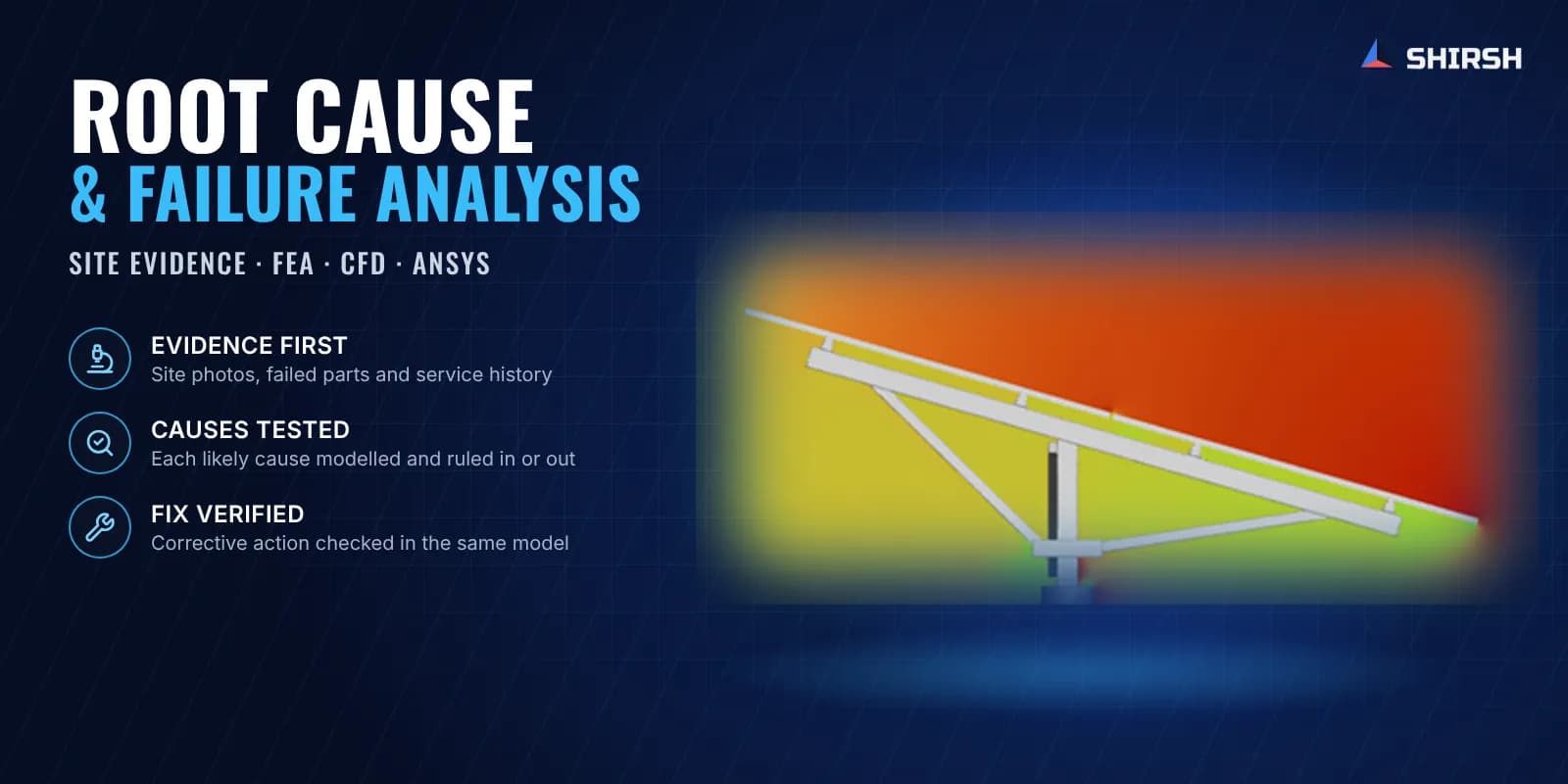
We start from the evidence: site photos, the failed part, inspection records and the operating history. Each likely cause is then tested in ANSYS until the results match what actually happened on site. We use FEA for stress, fatigue and vibration, and CFD where wind, flow or heat is involved. The fix is checked in the same model before it is built.
Pain points we address
Cracks, breakages or permanent deformation appearing in service
Failures that come back after a repair or replacement
Supplier, contractor and owner blaming one another
Warranty disputes that need a technical basis
Equipment that vibrates or runs hot with no clear reason
What we solve
Crack and fracture investigations of welded and bolted structures
Wind-induced failures of solar structures, masts and light frames, using CFD and FEA together
Fatigue and vibration failures traced to resonance or cyclic loading
Module glass and panel breakage linked to clamping, supports or deflection
Foundation and pile distress checked against the loads they actually carry
Design of the fix, verified in the same model
How we approach it
- 1
Collect site photos, the failed part where available, drawings, inspection records and service history
- 2
List every plausible cause, from overload and wind to fatigue and installation faults
- 3
Model the part or structure in ANSYS under its real service conditions
- 4
Test each cause and keep only the ones that match the site evidence
- 5
Design the corrective action and check it in the same model
- 6
Report the root cause, the evidence behind it and the recommended fix
Deliverables
Root cause analysis report with the evidence and analysis
FEA and CFD results for the failure scenario
Corrective action recommendations
Verification of the fix in the same model
Inspection or monitoring recommendations where useful
Expected outcomes
A root cause supported by evidence and calculation
A fix aimed at the cause, so the failure does not return
A technical basis for discussions between owner, supplier and contractor
Lessons fed back into the next design
Why Shirsh
A failure investigation needs a model that explains the evidence, and that takes design experience as much as analysis skill. We have spent years designing the kind of structures and equipment that end up on our desk after a failure, so we know which loads and details tend to get underestimated. When wind is involved, as it often is on solar structures and light exposed frames, we combine wind CFD with structural FEA. Our reports keep to what the evidence and the analysis show, and that matters when the supplier and the owner do not agree.
Where this lives
Industries served
Software used
Want to learn this?
We also offer ANSYS & SolidWorks training courses.
At a glance
Discuss your project with our engineers
Tell us about your simulation, validation or design challenge.