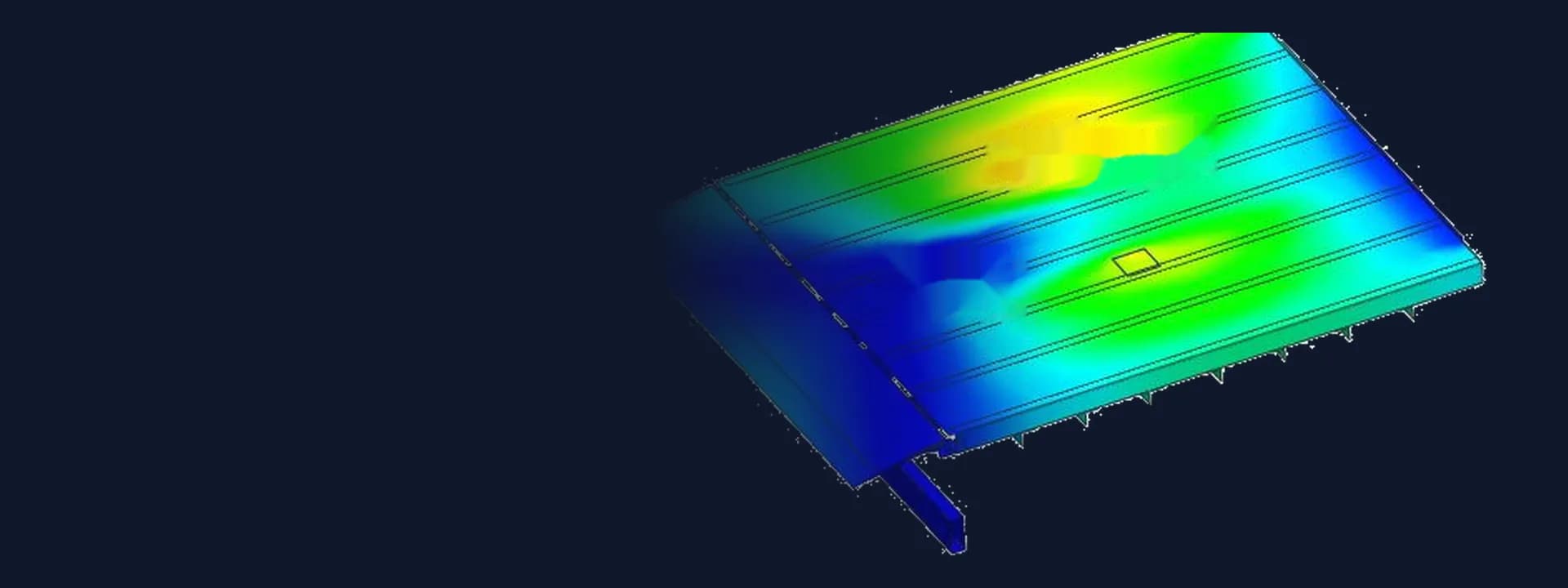
Dock Leveller Structural FEA to EN 1398
Structural FEA of a hinged-lip dock leveller range to EN 1398, checking safety factor, deck plate deformation and braking loads for each size.
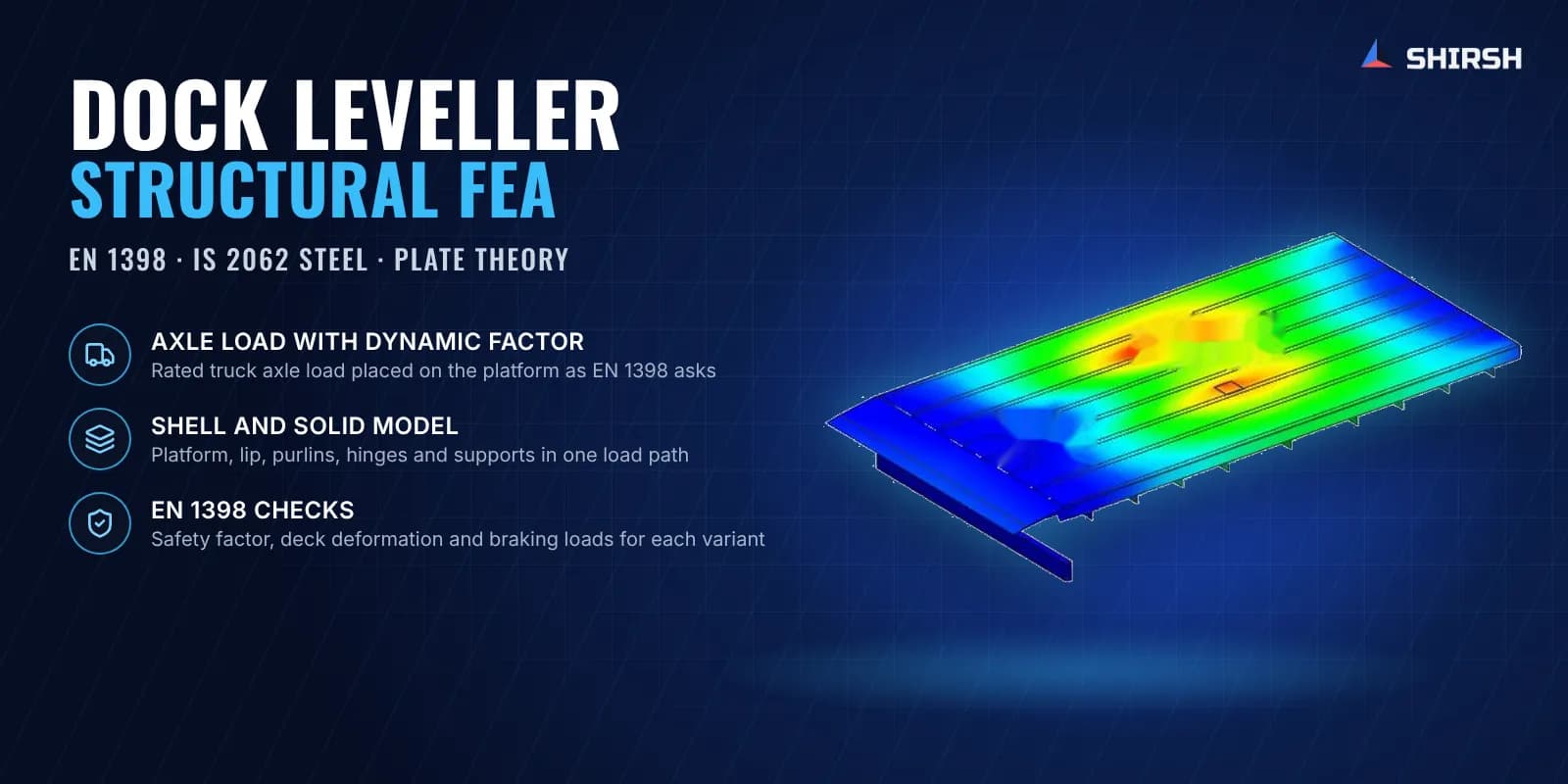
Project brief
A maker of industrial doors and loading-bay equipment wanted a structural stability report for its range of hinged-lip dock levellers, showing that each one meets EN 1398, the European safety standard for dock levellers.
Shirsh Technosolutions carried out a structural FEA of each leveller in the range, two platform lengths at two load classes. We applied the rated axle load the way EN 1398 describes it, checked the safety factor on the steel structure, worked out the permanent deformation of the deck plate between purlins by plate theory, and looked at the extra load from trucks braking and starting on the platform. The manufacturer got one report per variant with each EN 1398 clause and the result side by side.
What was at risk
A dock leveller looks simple. It is a steel deck that tilts on a rear hinge, with a lip at the front that rests on the truck bed, and a hydraulic cylinder underneath. In service it carries industrial trucks and pedestrians, the wheels run over narrow strips of deck plate between the purlins, and a moving truck loads the deck harder than its static weight would.
The manufacturer had several sizes and two capacity classes and needed every one of them checked the same way. The questions were:
what load the leveller has to be designed for under EN 1398, including the dynamic effect of moving trucks
whether the deck, purlins, stiffening angles and the bottom, front and back supports stay within a safe stress under that load
whether the unstiffened deck plate between purlins would dish permanently beyond the EN 1398 limit under a single wheel
whether braking and starting forces from trucks on the deck add anything significant
The client also sent a design-parameter checklist, so the report had to point to the EN 1398 clause behind every check.
Solution offered
Loads set out from EN 1398. The leveller width puts it in the class designed for pedestrian traffic and industrial trucks under EN 1398. We took the self weight of the steel structure as the dead load and applied the rated axle load, already multiplied by the dynamic factor, as two wheel patches on the deck at the axle track. Braking and starting forces from trucks were applied as a separate horizontal load case.
Dead load from the full steel structure of each variant.
Rated axle load including dynamic effect, as two rectangular wheel contact areas.
Braking and starting load as a horizontal force on the deck.
One finite element model of the whole leveller. The deck plate, lip, purlins, L-angle stiffeners and the bottom C-section, front tube and back support were meshed with shell elements, since each has a uniform thickness. Hinges, pipes and the hydraulic cylinder brackets were meshed with higher-order solid elements. The cylinder itself was represented by rigid links to its mounting points, bolted joints were modelled as bolt connections and welds as bonded contacts. Structural steel to IS 2062 was used throughout.
Checks against the standard. From the model we read von Mises stress, shear stress and deformation for the full structure and for each group of members. The safety factor on yield was compared with the minimum EN 1398 asks for under normal operation. For the deck plate, EN 1398 limits permanent deformation to a small fraction of the width of the unsupported strip between purlins, so we checked that strip by plate theory with one wheel load on it. A summary table at the end of each report put the EN 1398 limit and our result next to each other.
Common questions
What does EN 1398 check on a dock leveller? EN 1398 sets the safety requirements for dock levellers. On the structural side it defines the rated load and dynamic factor, the minimum safety factor for the steel structure in normal operation, and a limit on the permanent deformation of the deck plate between its supporting members. It also covers braking and starting forces from trucks on the deck.
Why use FEA for a dock leveller when it is mostly plates and channels? The load reaches the pit through the deck, purlins, stiffeners, hinge and cylinder brackets, and the stress peaks sit at joints and supports that hand calculations treat only roughly. A shell and solid model follows that real load path and shows which member is working hardest, while plate theory is still the quickest way to check local dishing of the deck under a wheel.
Challenges we overcame
A range of sizes and capacity classes that had to be checked the same way
Truck axle loads with a dynamic factor on top of the rated load
A load path through deck, purlins, stiffeners, hinges and cylinder brackets
Local dishing of thin deck plate under a single wheel
Horizontal braking and starting forces on top of the vertical load
A report that answers the client's design-parameter checklist clause by clause
How we executed
- 1
Collected the general arrangement, member sections and material data for each leveller variant from the client
- 2
Set the design loads from EN 1398: self weight, rated axle load with dynamic factor, and braking and starting load
- 3
Built a finite element model with shell elements for plates and sections and solid elements for hinges and brackets
- 4
Represented the hydraulic cylinder with rigid links, bolted joints as bolt connections and welds as bonded contacts
- 5
Applied the axle load as two wheel patches and solved for stress and deformation
- 6
Checked the safety factor on yield for the whole structure and for each member group against EN 1398
- 7
Checked permanent deformation of the deck plate between purlins by plate theory against the EN 1398 limit
- 8
Issued one structural stability report per variant with plots and an EN 1398 comparison table
Project outcome
Every leveller in the range met the minimum EN 1398 safety factor on yield under combined dead and rated axle load.
Deck plate deformation between purlins stayed within the EN 1398 limit for each variant.
Stresses from truck braking and starting were small compared with the vertical load case.
The manufacturer received a structural stability report for each size and capacity, with an EN 1398 comparison table at the end.
Project gallery
Where this lives
Related solutions
Industries
At a glance
We apply the same rigour to every engagement
Let us show you what's possible for your product.