HDPE Pharma Bottle FEA: Drop Test, Stack Load and Transport Vibration Simulation
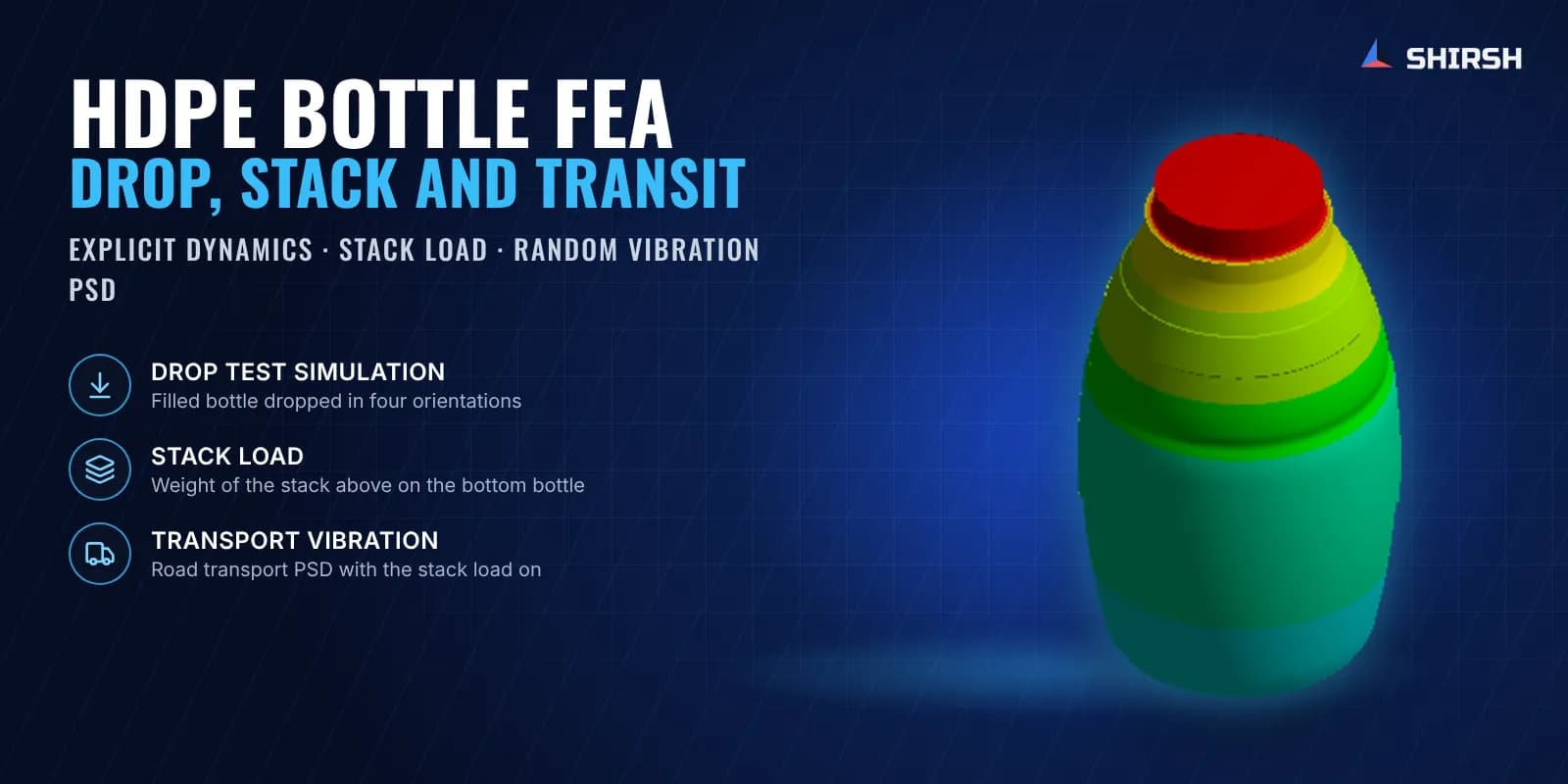
HDPE pharma bottle FEA: drop test in four orientations, stack load and random transport vibration simulated in ANSYS before mould release.
Project brief
A plastic container manufacturer was developing new moulds for 1-litre and 2.5-litre HDPE bottles, made for a pharmaceutical customer who wanted to see how the bottles would cope with handling, warehousing and road transport. Physical drop, stack and transit trials need finished moulds and real samples. The manufacturer wanted an engineering picture earlier, while the mould design could still change.
Shirsh Technosolutions ran an HDPE bottle FEA programme on the client's 3D assembly models of both bottles. It covered a drop test simulation of the filled 1-litre bottle in four orientations, a stack load analysis of both sizes, and a random vibration analysis of both sizes under a road transport vibration spectrum. The structural studies were done in ANSYS Mechanical, with the drop cases solved by explicit dynamics.
What was at risk
A thin-walled blow-moulded bottle full of liquid behaves very differently from a solid part. The wall is only a fraction of the cap thickness, the liquid adds mass and pushes outward on the wall, and the shape has ribs, a shoulder and a neck that each stiffen or weaken the bottle in their own way.
The customer had asked for the bottles to be checked for the usual packaging trials: drop, compression and stack load, and transit. They wanted to see the outcome for every drop direction, so the result could be explained to the end customer. A single static check would not answer that. A drop is a short impact, while a stack in a warehouse presses on the bottom bottle for weeks, and a truck shakes the whole load at low level for hours.
Solution offered
Model built from the client's CAD. We started from the client's assembly models of both bottles with their caps. The client confirmed the material, the bottle and cap wall thicknesses and the density of the liquid fill. The bottle was modelled in HDPE on a rigid steel plate, with its own weight and the hydrostatic pressure of the contents applied in every case.
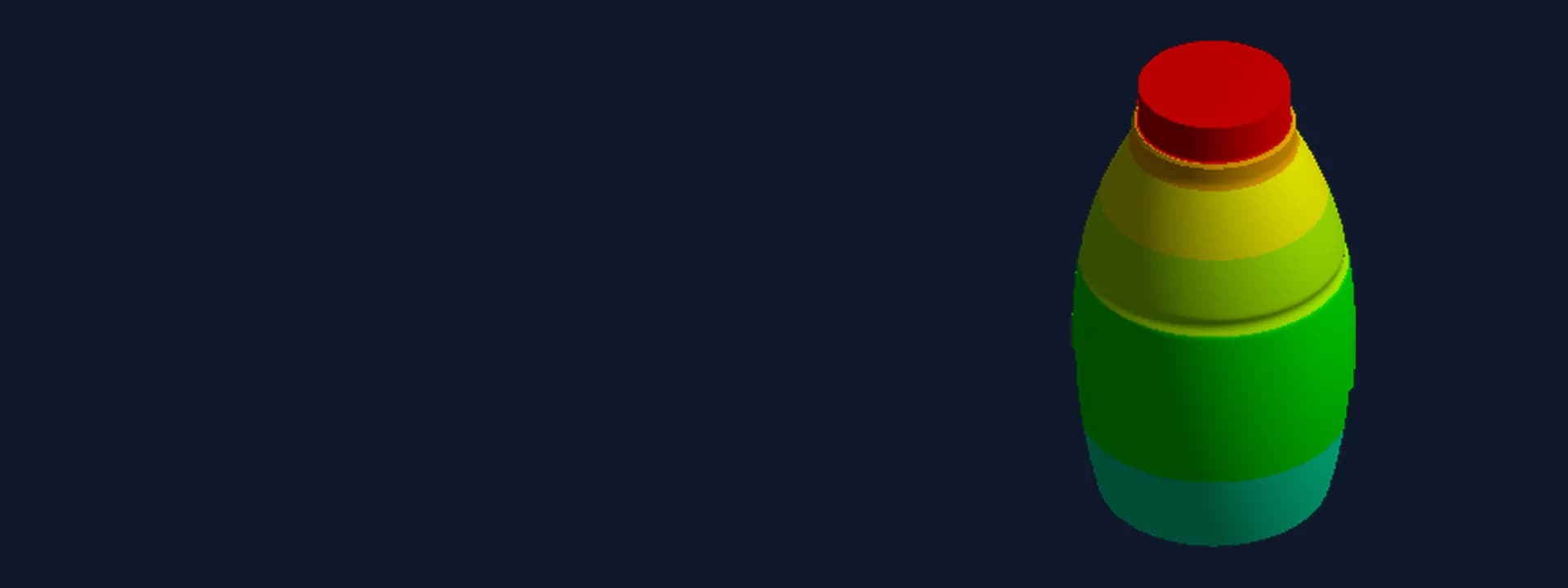
Drop test simulation. The filled 1-litre bottle was dropped onto a rigid floor in four orientations: upright with the cap up, upside down on the cap, tilted at 45 degrees, and lying on its side. The impact was solved with explicit dynamics, and each case was reported as total deformation through the impact, an animation of the event, and equivalent plastic strain to show where the wall yields and takes a permanent set.
Stack load analysis. For storage, we worked out the weight carried by the bottom bottle in a stack of filled bottles, from the empty bottle mass and the fill weight, for each size. That load was applied through a plate on top of the bottom bottle, together with self weight and internal liquid pressure, and the deformation and von Mises stress in the bottle wall were checked.
Random vibration for transport. To represent truck transport, a random vibration analysis was run on both bottles using a power spectral density curve for road transport vibration in India. The bottles carried the stack load and liquid pressure at the same time. Results were read at three sigma, which covers 99.73 percent of the expected response, as directional deformation and equivalent stress.
Results in a form the client could share. Each study went to the client as a short illustrated report covering materials, supports, loads and contour plots for every case, so the sales and quality teams could take it straight to their customer.
Common questions
Can a bottle drop test be simulated before the mould is made? Yes. With the bottle CAD, the wall thickness, the plastic properties and the fill, an explicit dynamics FEA can drop the filled bottle in any orientation and show where it deforms or strains permanently. It does not replace the final physical trial, but it shows the weak spots while the design can still change.
How is transport vibration checked on a plastic bottle? A random vibration analysis applies a power spectral density curve that represents truck transport to the filled bottle, usually with the stack load on top. The result is read statistically, often at three sigma, to see the likely deformation and stress the bottle wall will see during transit.
Challenges we overcame
Thin blow-moulded HDPE wall with ribs, shoulder and neck, carrying a liquid fill
Drop outcome needed for each orientation, from upright to upside down, angled and on the side
Stack load on the bottom bottle worked out from the fill and bottle weights for two sizes
Transit loading that is random rather than a single static force
Results that the client's team could explain to their own pharma customer
How we executed
- 1
Took the client's 3D assembly models of the 1-litre and 2.5-litre bottles with caps
- 2
Confirmed the HDPE material, wall and cap thicknesses and fluid density with the client
- 3
Applied self weight and hydrostatic pressure from the fill in every load case
- 4
Simulated drops of the filled 1-litre bottle in four orientations with explicit dynamics
- 5
Reported deformation, an impact animation and equivalent plastic strain for each drop
- 6
Calculated the stack weight on the bottom bottle and ran the stack load case for both sizes
- 7
Ran random vibration with a road transport PSD, together with the stack load, for both sizes
- 8
Issued illustrated reports for each test so the client could share them with their customer
Project outcome
The client had a drop, stack load and transport vibration picture for both bottles before committing the moulds.
The drop simulation showed where the filled bottle deforms and takes permanent strain in each of the four orientations.
Under random transport vibration the bottle wall stresses came out at a small fraction of those under the static stack load, for both sizes.
The illustrated reports gave the client's team material to explain the bottle behaviour to their pharma customer.
Project gallery
Where this lives
Software used
Related solutions
At a glance
We apply the same rigour to every engagement
Let us show you what's possible for your product.