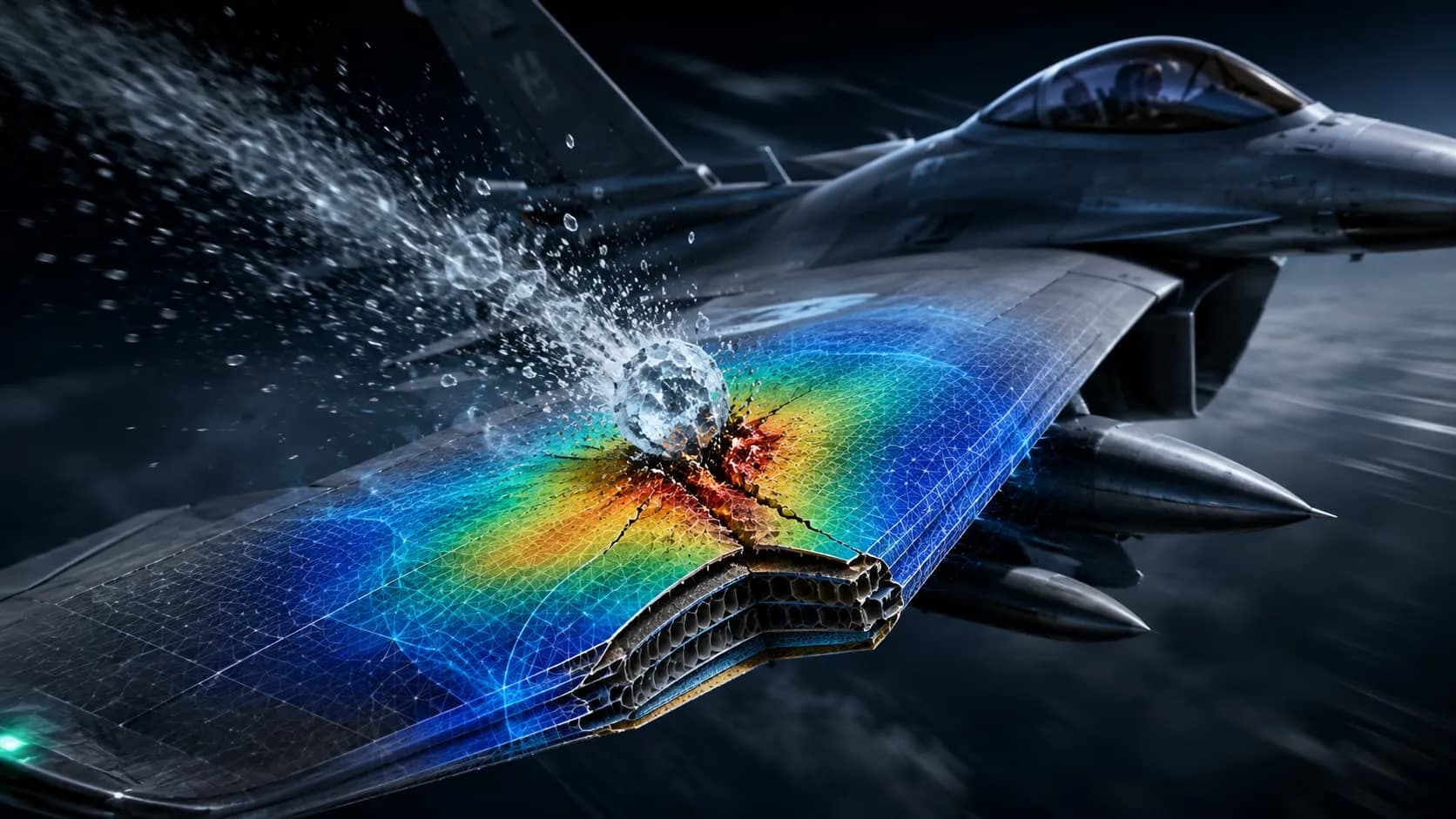
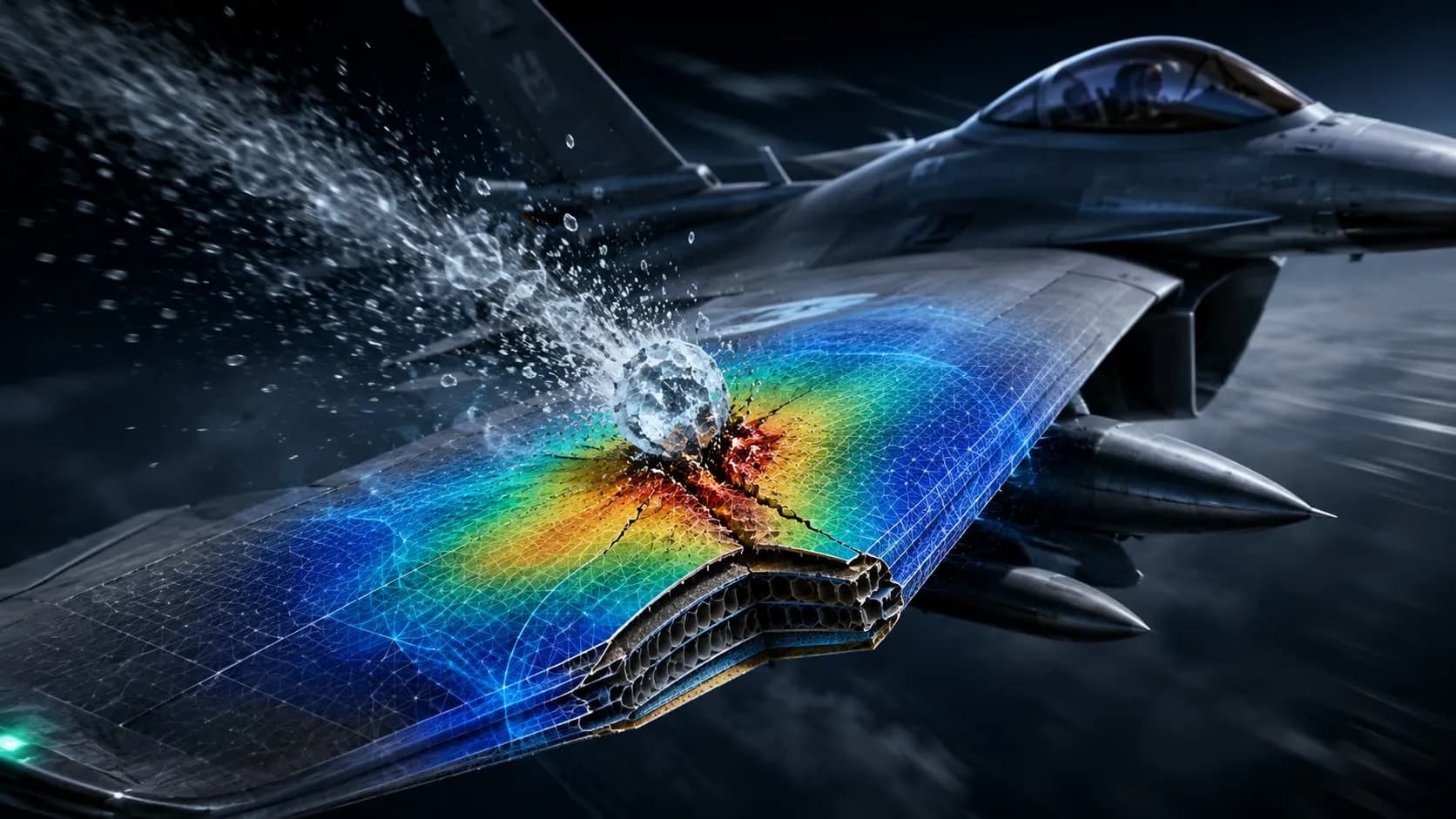
Advanced Explicit Dynamic Hail Impact Modeling on High-Frequency Aerospace Radomes
Utilizing high-velocity transient impact simulation to analyze progressive composite degradation and multi-strike damage tolerance on a aircraft radome.
Project brief
Aerospace radomes are highly specialized structures engineered to fulfill a dual purpose: providing aerodynamic and environmental shielding to internal radar equipment while maintaining absolute electromagnetic transparency. Operating under real-world conditions exposes these thin-walled assemblies to extreme transient hazards, such as severe wind-driven hailstorms.
This project explores a high-fidelity numerical assessment evaluating how a multi-layered composite sandwich radome behaves under severe, successive localized impact conditions. By leveraging explicit computational dynamics, this analysis maps out structural degradation pathways to ensure the asset maintains structural integrity during critical flight phases.
What was at risk
The primary engineering challenge lies in the complex structural architecture of the radome itself. To satisfy electromagnetic requirements across the 2–18 GHz band, the wall is designed as a lightweight sandwich configuration with a total nominal thickness of only 4.4 mm. This thin wall consists of multi-tiered fiber-reinforced composite laminates bounding a highly porous syntactic foam core.
The client's assessment required validating structural resilience against an aggressive threat profile:
Extreme Kinematics: A 3/4-inch spherical hail projectile striking the panel normal to the surface at a velocity of 850 km/h (236.1 m/s).
Fatigue Profiling: Evaluating structural tolerance over six consecutive impact events on an increasingly compromised local target zone.
Solution offered
A high-end Explicit Dynamic Nonlinear Analysis was developed to map real-time structural performance across all six chronological impact stages.The conceptual methodology focused on replicating true behavioral physics through the following techniques:
Advanced Particle Hydrodynamics: Rather than modeling ice as a simple rigid or traditional grid-mesh solid, the hail projectile was treated with continuum particle hydrodynamics. This captures progressive fragmentation, liquid-like scattering, and complex free-surface behavior at impact, matching the true physical mechanics of high-speed ice shattering.
Orthotropic Progressive Failure Mapping: The thin skin panels were defined utilizing fully orthotropic material properties, allowing the solver to independently track longitudinal fiber tension, transverse matrix cracking, and interlaminar shear wave transmission.
Energy-Absorbing Crushable Media: The internal core layer was configured with compressive stress-strain curves allowing it to function as a compliant, energy-dissipating medium. This accurately tracked the core's ability to collapse locally and cushion the inner skin from critical load paths.
Challenges we overcame
Multi-Layer Assembly Architecture: Mapped out the distinct thickness properties of the outer, middle, core, and inner layers while assuming perfect interlayer adhesion.
Hydrodynamic Discretization: Formulated the spherical projectile using particle states to reflect realistic fragmentation kinetics.
Boundary & Constraint Optimization: Secured the radome assembly at its mechanical mounting points to reflect realistic structural boundary conditions while allowing local flexing.
Chronological Step Execution: Solved six independent, sequential transient events, using automated small time-increments necessary to resolve high-frequency shockwaves.
Failure Criteria Evaluation: Extracted peak tensile stress states across the longitudinal and transverse ply directions to determine the exact structural damage margin.
Project outcome
The Elastic Threshold: The engineering design demonstrated exceptional resilience through the first three consecutive impacts, keeping tensile stress concentrations well below the ultimate material allowables.
Perforation Initiation: The fourth consecutive hit was identified as the structural threshold, where the accumulated strain triggered localized puncture (hole formation) confined strictly to the outer skin layer.
Degradation Mechanics: The simulation tracked how the energy-absorbing capability of the core gradually degraded during the fifth and sixth impacts, culminating in localized tearing on the inner composite skin layer.
Strategic Design Value: By clarifying the definitive margin between safe operation and localized degradation, the case study equips the client with data-driven service intervals and inspection protocols for aircraft operating in hail-prone regions.
Project gallery
Where this lives
Software used
Related solutions
At a glance
We apply the same rigour to every engagement
Let us show you what's possible for your product.