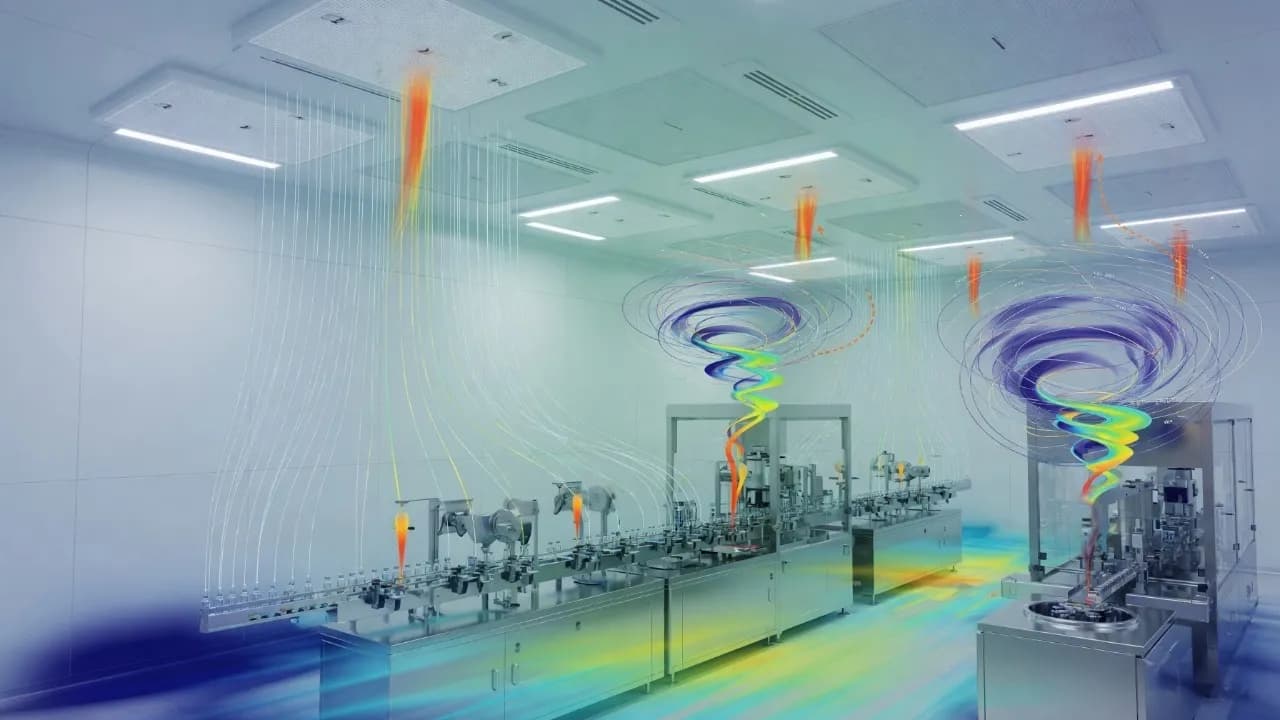
Why a Cleanroom Can Pass Certification and Still Contaminate Product
A particle count taken at a handful of certified sample points tells you the room is clean where you measured. It says nothing about the stagnant corner behind a filling line, the slow recirculating loop above a microscope, or the pocket of air near a return grille that holds onto contamination far longer than the air-change rate suggests. This is where CFD earns its place. By resolving the actual velocity field and tracking how particles move through it, simulation shows you the air a cleanroom forgets — the regions that pass paperwork but quietly drive your defect rate. With ISO 14644-5:2025 now asking facilities to justify their monitoring locations with airflow studies, that picture has gone from useful to expected.
Read the full article below for the methodology, the data, and the engineering decisions behind it.
The gap between "certified clean" and "actually clean"
Most cleanroom certification rests on a quiet assumption: that the room behaves like a well-mixed box. Pump in enough filtered air, count the particles at a statistically chosen set of points, and if the numbers fall under the ISO limit, the room is classified and signed off.
The assumption is convenient and, often enough, wrong.
A real room is not well mixed. Air entering through ceiling diffusers and leaving through low-wall returns sets up a flow field full of structure — fast streams, slow eddies, separation behind obstacles, and corners where the air barely moves at all. Two points a metre apart can have completely different histories. One sits in the clean downward stream from a HEPA face; the other sits in a recirculating loop that has been folding the same air over itself for minutes. The particle counter that visits the first point passes. The product that sits near the second collects defects nobody can explain from the certification record.
This is the central problem CFD addresses. The certificate measures cleanliness at a few sampled locations and a few sampled moments. CFD reconstructs the continuous field that connects them, and that field is where the trouble hides.
Why the air-change rate misleads you
Engineers lean hard on air changes per hour. An ISO 7 room runs somewhere around 30 to 60 ACH; an ISO 5 unidirectional space pushes 240 to 360. The intuition is that more air changes mean faster removal of contamination, and on average that holds.
The catch is in the word average. ACH is a whole-room number. It assumes every cubic metre of air gets swept out and replaced at the same rate. The recirculation zones break that assumption completely.
Picture a pocket of slowly rotating air trapped above a piece of equipment or in the lee of a partition. Fresh air streams past the outside of that loop without entering it. Inside, the air recirculates on itself. Its real residence time — how long a particle introduced there actually lingers — can be several times the figure you would predict from ACH alone. Washroom and enclosed-space studies have shown this directly: particles injected into a recirculation zone take far longer to clear than the air-change timescale implies, because what governs their exit is the residence time of that trapped pocket, not the bulk flow rate.
So when a process generates a burst of particles — an operator reaches across a bench, a door cycles, a tool vents — the question is not "what is the room's recovery time on paper?" It is "where did those particles land, and how long does that specific spot hold them?" ACH cannot answer that. The velocity field can.
What CFD actually puts in front of you
Run a properly set-up simulation of the room and you get four things you cannot get from a particle count.
The velocity field. Speed and direction at every point, not just at the diffuser face. This is where dead zones announce themselves: regions where velocity drops toward zero and the air simply sits. Near critical process locations, a dead zone is a place where settling wins and contamination accumulates.
Streamlines and recirculation structure. Following the flow reveals the closed loops — the eddies behind equipment, the roll cells under a raised floor, the curl of air near a poorly placed return. You see not just that air recirculates but where the loop sheds into the main stream and where it traps.
Recovery time, spatially resolved. Seed the room with a starting concentration, switch to a transient solve, and watch the cleanup. Instead of a single room recovery number, you get a map: this corner clears in 90 seconds, that pocket behind the isolator is still dirty after five minutes. That map is what tells you whether a disturbance near the product is a non-event or a problem.
Particle behaviour. Release particles of a given size and density and track them. Where do they settle? Which surfaces collect deposition? Do they reach the wafer, the open vial, the exposed product? Gravitational settling and turbulent dispersion both matter here, and a good particle model captures both.
Put together, these turn an abstract worry — "is contamination reaching the product?" — into a concrete, located answer.
The modeling choices that decide whether you can trust the result
CFD is only as honest as its setup. A pretty contour plot from a careless model is worse than no model, because it carries false confidence. A few decisions matter more than the rest, and this is where experience separates a usable study from a decorative one.
Turbulence model. The field has lived on the standard k-ε model for years, and for good reason — it is cheap and stable. But k-ε is known to mishandle exactly the features cleanroom engineers care about: low-velocity regions, recirculation, and flow near walls. The trend in recent work is toward RNG k-ε and SST k-ω, which behave better in separated and low-Reynolds flow and resolve near-wall behaviour more faithfully. For unidirectional spaces where the whole point is gentle, uniform, low-turbulence flow, the choice of model materially changes whether you predict a clean piston of air or a field riddled with spurious mixing. Picking the model to match the physics — not the default in the menu — is the first real decision.
Steady versus transient. A steady solve gives you the established flow pattern and is enough to locate dead zones and recirculation. But recovery time, door cycles, personnel movement, and any disturbance you care about are inherently time-dependent. Those need a transient run, which costs far more compute. Knowing which questions genuinely require transient analysis — and which can be answered steady — is how you keep a project affordable without cutting the analysis that matters.
How you model the inlet. A HEPA diffuser is not a flat velocity boundary. Modern practice resolves the diffuser geometry rather than smearing it into a uniform inlet, because the jet structure coming off the face drives the recirculation pattern downstream. Simplify the inlet too aggressively and you can erase the very eddy you were hired to find.
The particle model. For tracking discrete contamination, the Euler–Lagrange approach — following individual particle trajectories through the flow — has become the preferred method over treating particles as a continuous concentration field (Euler–Euler). It handles settling, wall deposition, and the fate of individual releases in a way that maps cleanly onto how contamination actually behaves. The turbulent Schmidt number, particle size distribution, and density all need defensible values, not guesses.
Mesh independence. Recovery times and deposition predictions shift with mesh refinement until the mesh is fine enough. A study without a mesh-independence check is a study you cannot defend. This is dull, unglamorous work, and it is non-negotiable.
Boundary conditions from reality. The single most common way these studies go wrong is feeding them invented numbers. Supply velocities should come from measured air balance or FFU performance curves; thermal loads from real people, lighting, and equipment heat; contaminant generation from documented emission rates. For an existing room, the as-built air balance and field measurements are the inputs. For a new design, the basis-of-design figures. Garbage boundary conditions produce confident, wrong contours.
Reading the results like an engineer, not a tourist
A contamination problem in a cleanroom usually traces back to one of a few patterns, and once you know what they look like in the field, the simulation reads quickly.
A dead zone over a critical location means settling beats sweeping. Particles generated anywhere upstream that drift into this region stop being carried to the return and start landing on whatever sits below. The fix is rarely "more air" — it is redirecting flow or relocating a return so the air actually moves through that volume.
A recirculation loop above the process is the slow poison. It does not look dramatic; velocities are modest. But it recycles contamination back over the product instead of carrying it away, and its long residence time means a single disturbance keeps re-presenting particles for minutes.
A stagnant corner near a return is the cruel one, because intuition says air near a return should be moving. If the return is poorly placed relative to the supply, the flow can short-circuit straight from diffuser to grille and leave a quiet pocket beside the very vent meant to clean it.
Then there are the disturbances the steady picture misses. A person walking through a room is a moving heat source dragging a turbulent wake behind them, and that wake lifts settled particles back into the breathing zone. Studies put the resuspension from a single operator at thousands of particles a minute. Heat plumes off equipment do the same thing more quietly, setting up buoyant updrafts that fight the designed downward flow. A model that ignores thermal loads and movement will show a calm room that does not exist once people start working in it.
The regulatory ground has shifted
For a long time, CFD in cleanrooms was a design-stage nicety — useful for laying out diffusers and returns before the steel went in, then forgotten. That is changing.
ISO 14644-5:2025 is the most substantial revision to cleanroom operational standards in two decades, and it moves the field away from prescriptive, one-size-fits-all rules toward documented risk assessment. In practice, facilities are now expected to justify where they place monitoring points rather than scatter them by rule of thumb — and the standard points to airflow visualization studies as the way to do it. CFD and smoke studies sit naturally in that role. If you have to defend why your particle counters live where they live, a velocity field showing which regions are worst-case for stagnation and recirculation is exactly the evidence the auditor wants.
The unidirectional-flow expectations reinforce this. The FDA's reference figure of 0.45 m/s ± 20% at the working level is easy to state and hard to actually achieve uniformly once equipment, isolators, and people enter the space. CFD is how you check whether that velocity holds across the work zone or collapses behind an obstruction long before anyone runs a smoke pencil.
The honest framing: CFD does not replace measurement and it does not replace smoke studies. It tells you where to point them, and it explains why a measured result came out the way it did. Validation still runs the other direction — you anchor the model against measured air balance and visualization, then trust it to fill in the continuous picture between your sample points.
Where this is heading
A few currents are worth watching.
Scale-resolving turbulence models — LES and the lighter-weight Scale-Adaptive Simulation — are becoming affordable for room-scale problems as GPU solvers mature. These capture the unsteady eddies that the older averaged models smear out, which matters a great deal for transient contamination events. The cost is still real, but the gap between "research only" and "routine project" is closing.
Digital twins are the more ambitious direction. The idea is to keep a calibrated CFD model of a working room alongside live sensor data, so the model is continuously checked against reality and can predict the effect of a layout change or a process disturbance before anyone makes it. Predictive contamination control, rather than reactive cleaning after a defect spike, is the goal a lot of high-value manufacturing is moving toward.
Reduced-order models sit between the two — fast surrogates trained on full CFD runs that let an operator explore "what if we move this tool" without re-solving the whole field. They trade some fidelity for near-instant answers, which is often the right trade for day-to-day decisions.
None of this removes the need for a properly built underlying model. Faster solvers and cleverer surrogates only amplify whatever is in the boundary conditions and the turbulence choice — for better or worse.
Where teams get stuck, and where we help
In our experience, cleanroom CFD goes wrong in predictable places. Boundary conditions get assumed instead of measured. The default turbulence model gets used because it ran without complaint. The diffuser gets simplified into a flat inlet and the recirculation that mattered disappears. A steady run gets used to answer a question that was always transient. Mesh independence gets skipped because the deadline is close. And the result gets presented as truth without ever being anchored against a smoke study or field data.
Each of these is avoidable, and avoiding them is most of the job.
This is the work Shirsh does. We build cleanroom airflow and particle-transport models grounded in real air-balance and FFU data, choose turbulence and particle models to match the actual physics rather than the convenient default, run the mesh-independence and validation steps that make a study defensible, and resolve the diffusers and thermal loads that drive the patterns you actually care about. The deliverable is not a gallery of contour plots — it is located, actionable findings: this corner stagnates, this loop recirculates over your product, move this return, and here is the recovery-time map that justifies where your monitoring should sit under the new ISO 14644-5 risk-based expectations.
If you are designing a room and want the layout right before the steel goes up, or you have an existing space with a defect rate that the certification record cannot explain, that gap between "certified clean" and "actually clean" is exactly what we work in.
Shirsh TechnoSolutions provides CFD and FEA consultancy for industrial and process engineering. For cleanroom airflow studies, contamination-risk modeling, and design optimization, get in touch.
Click to view full size
Want to Apply This to Your Product?
Our engineers can help you implement these techniques on your specific components and assemblies.
Get insights like this in your inbox
Engineering deep-dives, simulation tips, and industry analysis. No spam, unsubscribe any time.