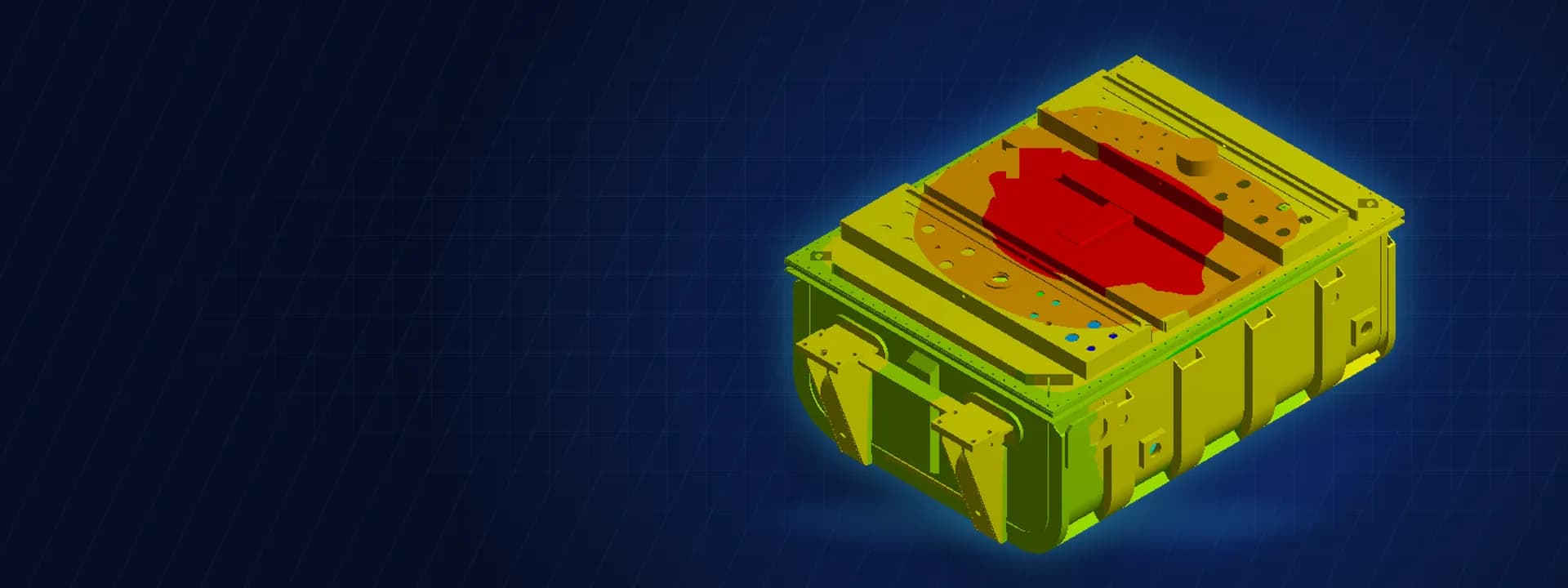
IEC 61373 Vibration and Shock FEA of an Aluminium Rail Transformer Oil Tank
IEC 61373 random vibration and shock FEA of an aluminium transformer oil tank for electric locomotives, run in ANSYS at functional and long-life levels.
Project brief
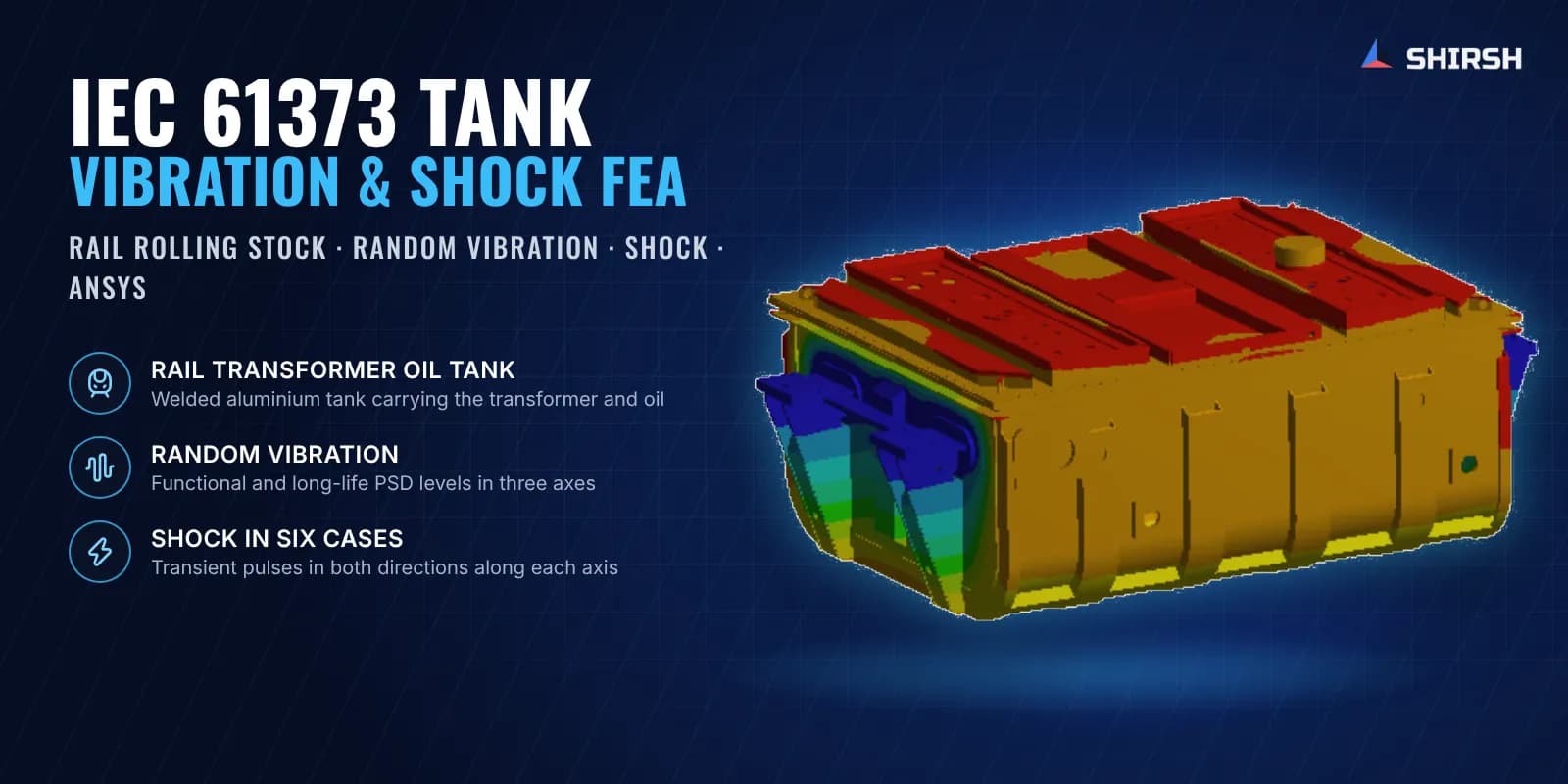
A heat exchanger and tank maker supplying the rail sector was building an aluminium oil tank for the main transformer of a new electric locomotive. The tank carries the transformer and its oil, and it hangs on the locomotive body for its whole service life. The railway customer wanted proof that the welded aluminium tank would survive the shock and vibration seen in service, as set out in IEC 61373.
Shirsh Technosolutions carried out the IEC 61373 vibration analysis in ANSYS Mechanical. We ran a modal study of the filled tank, random vibration at both functional and simulated long-life levels in all three axes, and then a transient shock study in both directions along each axis. The work gave the maker a code-referenced FEA report it could put in front of the railway customer.
What was at risk
A locomotive transformer tank is heavy, and most of that weight is the transformer core and oil sitting inside a fairly thin aluminium shell. Track input reaches the tank through four mounting pads. If one of the tank's natural modes falls inside the excitation band, the wall panels and stiffeners can see far higher stress than a simple static check would show.
IEC 61373 defines the test spectra by the mounting location on the vehicle, and the customer fixed the tank as body-mounted equipment. The maker asked for this to be shown by finite element analysis, following the same test sequence the standard lays down. The tank also mixes three aluminium alloys across the body, side plates, mountings and bushing plate, so each part needed its own yield-based check.
After the random vibration report had gone to the railway customer, the maker asked for the IEC 61373 shock test to be covered as well. That meant six more transient cases on the same model.
Solution offered
We built a solid model of the tank body, lid, mountings, bushing plate and side plates from the maker's 3D data and drawings. Fasteners, small holes, chamfers and fillets were removed. The bolted lid and the welded joints were treated as bonded, and a second-order solid mesh was used. An error plot showed the mesh was fine enough in the general regions.
The transformer and oil were added as a distributed mass inside the tank body, and the tank was fixed at its mounting pads. A modal analysis of the filled tank gave the first six natural frequencies and mode shapes, which then fed the random vibration runs.
Random vibration was run as a PSD base excitation using the IEC 61373 acceleration spectra for body-mounted equipment:
Functional test levels in the vertical, transverse and longitudinal directions.
Simulated long-life test levels in the same three directions.
Deformation and von Mises stress reported at the 3-sigma level of the random response.
For shock, we ran a transient structural analysis with the IEC 61373 shock pulse sequence applied along each axis in the positive and negative directions. That gave six cases, each with deformation against time and a stress plot capped at the allowable stress so that any region above it stood out clearly.
Stresses were compared with an allowable stress set below the yield strength of the weakest alloy in the tank.
Common questions
What does IEC 61373 require for railway equipment like a transformer tank? IEC 61373 sets random vibration and shock test levels for rolling stock equipment, based on where the equipment is mounted on the vehicle. It covers functional random vibration, a higher simulated long-life random vibration test, and shock pulses in each axis.
Can FEA replace a shaker test for IEC 61373? FEA is used before testing to predict deformation and stress at the IEC 61373 levels, find weak spots and fix the design early. It reduces the risk of failing the physical test. The final acceptance route is still agreed between the supplier and the railway customer.
Challenges we overcame
Heavy transformer and oil mass carried by a thin welded aluminium shell
Three different aluminium alloys across the body, side plates and mountings
IEC 61373 spectra selected for body-mounted equipment in three axes
Functional and simulated long-life random vibration levels on one model
A shock test scope added after the random vibration report was issued
Picking out small local regions above the limit in the shock cases
How we executed
- 1
Reviewed the maker's 3D model, drawings, alloy list and weight data, and agreed the IEC 61373 mounting category with the customer
- 2
Built and simplified the solid model of the tank assembly and meshed it with second-order elements
- 3
Added the transformer and oil as distributed mass and fixed the tank at its mounting pads
- 4
Ran a modal analysis of the filled tank to get its natural frequencies and mode shapes
- 5
Ran PSD random vibration at functional and long-life levels in the vertical, transverse and longitudinal directions
- 6
Ran transient shock analysis in both directions along each axis
- 7
Checked deformation and von Mises stress against the alloy-based allowable stress
- 8
Issued a signed FEA report with the result plots for the railway customer's review
Project outcome
Stresses under functional random vibration stayed below the allowable stress in all three directions, so the tank met the IEC 61373 functional requirement.
Stresses under long-life random vibration also stayed below the allowable stress in all three directions.
In the six shock cases, the tank body stayed within the limit apart from a few very small local regions, which were located and reported for the maker's review.
The maker received one report covering modal, random vibration and shock results, ready for the railway customer's design file.
Project gallery
Where this lives
Software used
Related solutions
Industries
At a glance
We apply the same rigour to every engagement
Let us show you what's possible for your product.