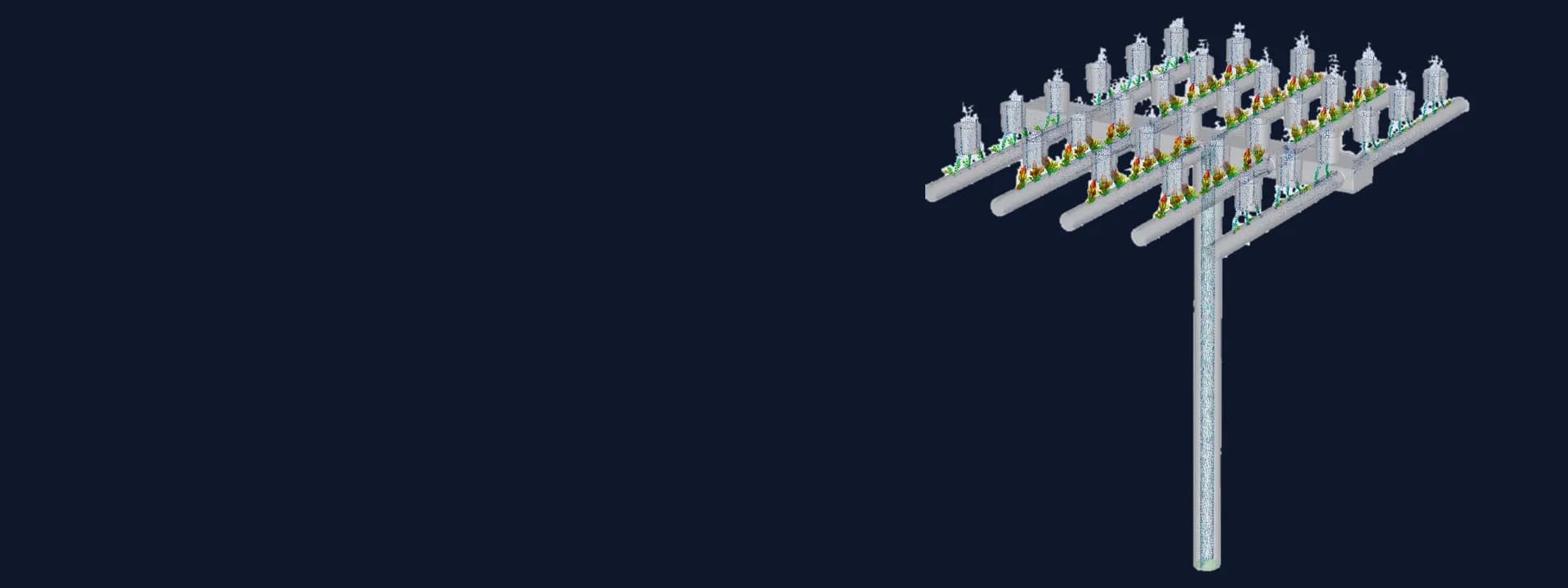
Bottle Washer CFD: Rinse Jet Coverage, Water Use and Wash Cycle Time
Multiphase CFD of an automatic bottle washer in ANSYS Fluent to check jet coverage, minimum rinse water, pump duty and soap-tank cycle time.
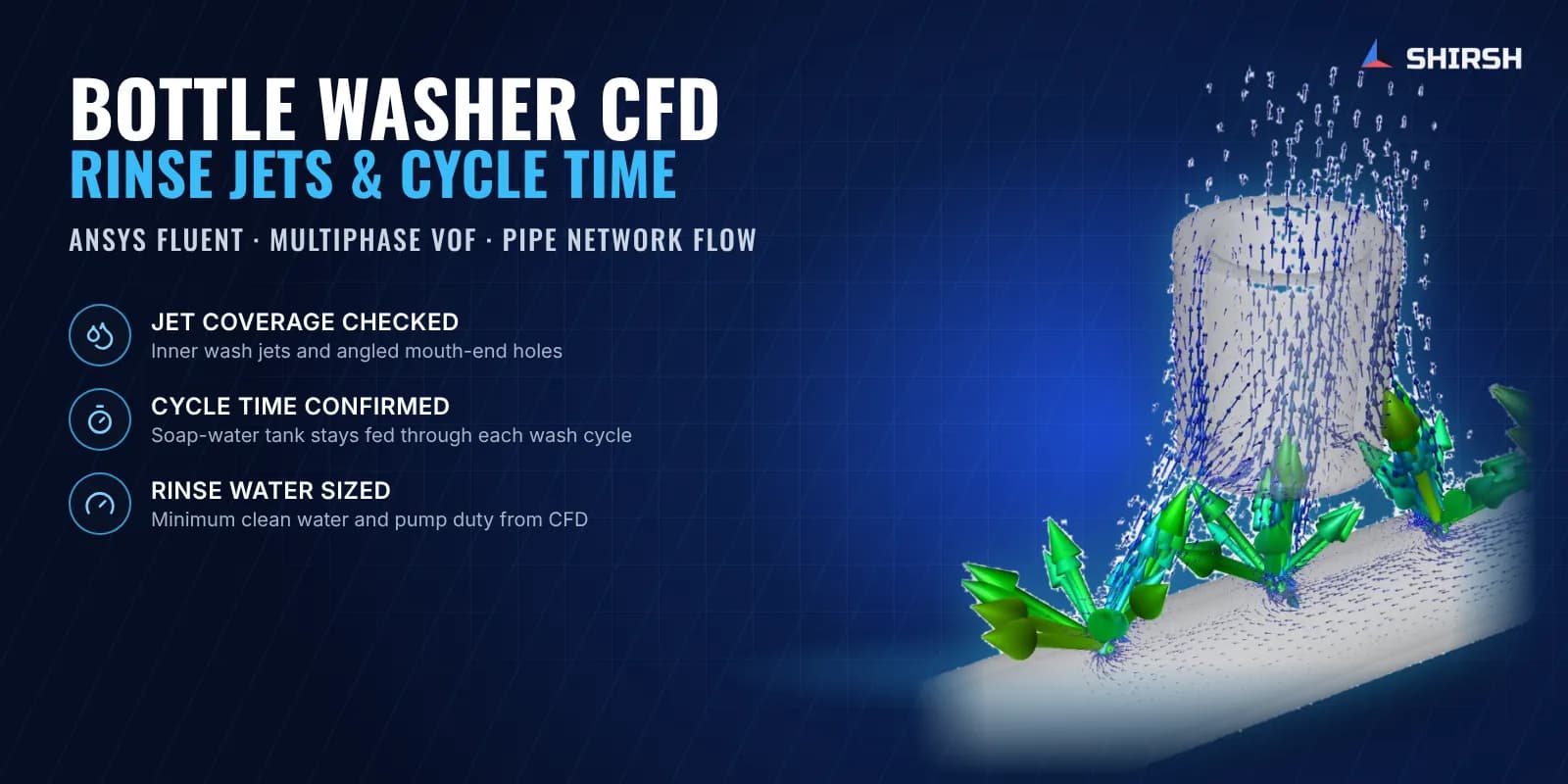
Project brief
An equipment maker was developing an automatic bottle washer that cleans a full rack of bottles inside and out in two stages, a soap-water wash followed by a clean-water rinse. Pumps feed a pipe network under the rack, and jets from small holes in the header pipes shoot up into each inverted bottle. Before fixing the pump, tank and holes, the team wanted to know how much water each stage really needs and whether the soap-water tank could keep up with the cycle.
Shirsh Technosolutions carried out bottle washer CFD in ANSYS Fluent. We modelled the pipe network to get the jet velocities at every hole, then ran multiphase (volume of fluid) simulations of a single bottle being filled and drained, with published properties for soap water. A cycle-by-cycle water balance built from these results gave the minimum clean water, the pump duty and the time each wash stage takes.
What was at risk
A bottle washer looks simple, but the numbers that size it are hard to guess. The jets must reach the bottom of every bottle in the rack, and the outer mouth of each bottle needs its own wash. Soap water behaves very differently from plain water: it is far more viscous, wets the wall more readily and has a lower surface tension, so it fills, clings and drains in its own way.
The soap stage runs from a small recirculating tank. If the pump draws water out faster than it comes back from the bottles and the network, the tank runs dry mid-cycle. The clean-water stage is a one-pass rinse, so every extra litre is wasted water.
The client needed answers to a few practical questions:
the jet velocity at the holes for the chosen pump, and how evenly the network shares the flow
how long a bottle takes to fill and drain, and how much soap water stays on the walls
whether the soap-water tank holds enough for one cycle, and the minimum clean water for the rinse
Solution offered
Pipe network CFD. We extracted the fluid volume from the client's 3D model of the feed pipe, header, branches and nozzle cups and solved the steady incompressible flow in ANSYS Fluent with a polyhedral mesh. The run gave the velocity at each outlet hole, the pressure drop along the network and the flow split at the junctions, separately for the soap-water and clean-water pumps.
Single-bottle multiphase CFD. Using the hole velocity from the network run as the inlet, we simulated one inverted bottle with the free surface tracked by the volume of fluid method. Clean water and soap water were modelled with their own density, viscosity, contact angle and surface tension, taking published data for soap solutions. The runs showed how fast each bottle fills, how the liquid film forms on the wall and how much liquid comes back to the tank.
Mouth-end cleaning with angled holes. The original layout focused on washing the inside of the bottles. We proposed extra holes drilled at an angle in the header pipes so that jets also hit the outer neck and mouth, and ran the network and jet CFD again with these holes included to confirm the coverage.
Water balance and cycle time. From the CFD flow rates we built a second-by-second balance of the soap-water tank: water drawn by the pump, water returning from the network, from the upper cleaner and from the bottles. The same approach gave the total clean water needed per rinse, split between internal cleaning, mouth-end cleaning and the upper cleaner.
Design inputs for the machine. The report gave the client a pump capacity for each stage, the cleaning time for each cycle, confirmation that the soap-water tank stays fed when the cycle time is kept within the calculated limit, and the minimum clean water for each rinse.
Common questions
How does CFD help size a bottle washer? A pipe network model gives the real jet velocity at every hole for a given pump. A multiphase model of one bottle then shows fill time, drain time and how much liquid stays on the wall. Put together, these give the water used per cycle, the pump duty and whether the tank can keep up.
Why model soap water separately from clean water? Soap solutions are much more viscous than water and have a lower surface tension and contact angle. They fill and drain bottles more slowly and leave more liquid on the walls, so a water-only model would understate the cycle time and the tank demand.
Challenges we overcame
Jets from many small holes needing the right velocity at every bottle in the rack
Soap water with very different viscosity, wetting and surface tension from plain water
A recirculating soap tank that could run dry if the cycle ran too long
Cleaning the outer mouth of each bottle, not only its inside
Turning flow results into a pump, tank and water budget the client could build to
How we executed
- 1
Extracted the fluid volume from the client's 3D model of the washer pipe network and nozzle cups
- 2
Collected soap water density, viscosity, contact angle and surface tension from published data
- 3
Solved the pipe network in ANSYS Fluent to get hole velocities, pressure drop and flow split
- 4
Ran multiphase volume of fluid simulations of a single bottle for soap water and clean water
- 5
Proposed angle-drilled holes in the header for mouth-end cleaning and checked them with CFD
- 6
Built a second-by-second water balance of the soap-water tank over one wash cycle
- 7
Worked out the clean water needed for internal, mouth-end and upper cleaning in one rinse
- 8
Reported pump capacity, cycle time and minimum water for each stage
Project outcome
The CFD gave the jet velocity at every hole for each pump, giving the client a sound basis for pump selection.
The soap-water tank balance showed the tank stays fed through the cycle when the cleaning time is kept within the calculated limit.
The minimum clean water for each rinse was quantified and split between internal, mouth-end and upper cleaning.
Angle-drilled holes in the header were checked with CFD so the outer mouth of each bottle can be washed in the same cycle.
Project gallery
Where this lives
Software used
Related solutions
Industries
At a glance
We apply the same rigour to every engagement
Let us show you what's possible for your product.